Showing posts with label Baseball. Show all posts

Monday, June 9, 2025

When I was quoted in USAToday about the Rays


(This is a cross-post of an article I wrote on my professional website years ago. I am closing that site down to save some money.)

A few weeks ago, I closed down my blog on baseball in Tampa Bay. It was a great research project, one I put a lot of hours into, but one I couldn't see continuing from 7,000 miles away. I wrote 1,200 words on why I was putting the site on hiatus and as well why I was not positive the Tampa Bay Rays would ever be able to make things work in Tampa Bay.


Final posts are always tough and I was sad to close it up, but as I mentioned on the blog, it was time.


Little did I expect after writing that post that the Tampa Bay Rays would ship off several of their veteran players, claim to be "rebuilding", and be in the critical crosshairs of many national sports writers.


Even less did I expect to be cited in one of those articles. Definitely a nice surprise.

The USAToday.com article, "The Tampa Bay Rays haven't outdrawn the Lightning in 5 years and desperately need to relocate", was written by baseball writer Ted Berg. I'm pretty sure I have corresponded with Berg a few times on twitter.


In the article, Berg cites me often, writing about my blog overall and then linking to several of my research posts, including my posts on baseball research site Fangraphs.com. All great compliments that made me smile from across the world. Berg sums up my blog well, writing,

Lortz’s site has an incredible wealth of information on the topic and is well worth checking out.

He also sums up my current attitude about Tampa Bay baseball well:

Essentially, a baseball fan in the Tampa area spent years diving deep into data to try to figure out how to make Major League Baseball in the Tampa area work and concluded that, given all the factors in play, it might be hopeless.

Perfectly written.


It is always nice to be recognized as a subject matter expert, especially in the crowded field of sports writing. I was able to bring a unique look at a niche subject. And people in the know read my work and shared it.


That makes the effort all worth while.

Thursday, April 4, 2024

Not so Serious Movie Review: Damn Yankees


I finally watched the movie Damn Yankees. In March of 2023, I read the novel The Year the Yankees Lost the Pennant by Douglass Wallop, the book from which Damn Yankees is based. The movie and the musical took the novel to another level as most people now associate the story with the Damn Yankees title and not the book's original title.

Several of the reviews for Curveball at the Crossroads have mentioned Damn Yankees, inspiring me to find the movie and the book. There are some similarities, although my novel is based more on blues music and southern folklore. Damn Yankees is a more generic Faustian tale.

What I liked:

  • As far as I remember, the movie stuck pretty true to the novel. 
  • It's light, quick, and fun - an easy watch. 
  • The Yankees lose. Which is always a good thing.

Being a musical and made in the 1950s, the movie doesn't get too deep into the dark side of a deal with the Devil. Ray Walston keeps the Devil humorous and mischievous. He is evil, but with a quick wit. After working with the Devil in my novel, I like seeing how the Devil is portrayed in other works.

My biggest critique of the movie has to be why "Who's Got the Pain" was part of the production. While impressive for its dancing, it doesn't advance the story at all.

If it wasn't a musical, the movie could have dove deeper into the characters. I thought Lola was especially overrated. She is a side character at best and definitely doesn't deserve to be the focus of the poster. But Gwen Verdon is an amazing dancer and steals the show in her dancing scenes, and that's the focus of musicals, hence she is the biggest face on the poster. 

On a related note, no offense to Gwen Verdon, but she doesn't come off as a temptress very well. The fake accent scene didn't make sense and not until the end does the viewer get the idea that Joe Hardy might even like Lola. She is more concept than character. The novel version of Lola is a bit more tempting. Neither are as seductive as Kim Bassinger in The Natural, however.

Overall, Damn Yankees is recommended. Especially if you have read Curveball at the Crossroads. I also recommend reading The Year the Yankees Lost the Pennant, which I like to think is Curveball at the Crossroads's spiritual predecessor.

Side note: I realized after watching Damn Yankees that the song "Heart" is from the musical. I have seen the video of the 1969 Mets on the Ed Sullivan Show performing the song many times but never knew where it was from. Mystery solved.

By the way, could someone look less excited than Nolan Ryan being forced to sing on late night television?


Thursday, October 19, 2023

Thoughts on the passing of Tim Wakefield


I had the honor and pleasure of writing a piece on BallNine.com recently on the passing of former Boston Red Sox pitcher and hometown hero Tim Wakefield. Thanks to the Chris Vitali and the team at BallNine for letting me cameo over there.

REMEMBERING WAKE - BallNine.com, 10/13/2023

Monday, September 25, 2023

Edwin Jackson and the traveling Virgos


Growing up, I wanted to be a Major League Baseball player. For whatever reason, fate had other plans. But as it turns out, I share a birthday with several Major League Baseball players and a professional lifestyle with a very special group of those players.

There are 63 Major League Baseball players who share my September 9th birthday. There are a few Hall of Famers (old school stars Frankie Frisch, Waite Hoyt, and Frank Chance), several all-stars, and a few coaches (Tampa Bay Rays pitching coach Kyle Snyder was born on the exact same day).

Of that group, what is especially interesting about my birthday is the amount of extremely travelled ballplayers born on September 9th.

According to MLB.com research, there are 47 players in professional baseball's 160 year history who have played for 10 or more teams. To be good enough to play is an accomplishment, to be wanted by ten or more teams over the course of a career is a peculiar and interesting oddity. Of the 23,000 professional baseball players, those who have been on 10 or more teams is a microscopic 0.2 percent.

Of that 0.2 percent, approximately 13% were born in September. An even dispersal would have been four per month, but as you can see on the below chart, September has six, 50% more well-traveled Major Leaguers.


If we dive into September's data and we look at the six players who comprise this month of well-traveled professionals, we discover an even more interesting coincidence.


Of the six players born in September who played for more than 10 Major League teams, three are born on September 9th. More well-traveled players are born on September 9th than any other day, including Edwin Jackson, who holds the Major League record for being on 14 different teams. The only other day on which more than one well-traveled baseball player was born is February 14, the birthday of two players who played for 10 or more teams.

I could look up every date and see the average for teams played for per date, but that would be a lot of research and I don't have the time or energy for that. But I did look up September 9th. The 63 ballplayers with whom I share a birthday have been on an average of 3 teams. I didn't do the research on the other 364 days, so I don't know if that is above or below average. Of the 63 of the 23,000 people to ever play in the Major Leagues, three played for more than 10 teams. So in total, 0.013% of all Major League Baseball players ever born were born on the same day and played for 10 or more teams.

That day happens to be my birthday, September 9th.

Ironically, I have also had a well-traveled career. Since my first job at McDonalds in high school, I have worked for 17 different companies in 28 years. Since 2006, when I entered the defense contracting field, I have worked for 10 different companies, including more than half of the top 10 companies in the industry.

Not to brag, and not to downplay their struggle to stay in Major League Baseball, but I think my journey might be more stressful. Perhaps not physically, as they have had to move cities more often, but my journey may have been more difficult mentally. Whereas they have stayed in Major League Baseball, and been good enough to play at the top level for more than ten teams, they have still been under the same umbrella organization of Major League Baseball and the Major League Baseball Players Union. They have always been Major Leaguers and had the benefits, salaries, privileges, and protections thereof. When I leave organizations, I am done. My benefits go away, my protections disappear, and I am out on my own. I also don't have an agent making calls on my behalf looking for my next job.

Maybe it is something on who we are as Virgos born on the 9th that makes traveling and moving from job to job a regular behavior. Maybe our analytical instincts lead us to find new teams and organizations to work with in our industries.

With Edwin Jackson, Todd Zeile, and Dan Miceli no longer in baseball, I guess it is up to me to continue our shared birthday's wandering professional lifestyle.

Anyone hiring?

Monday, August 7, 2023

Drowning in Junk Wax


Like many Gen X baseball fans, I was a big baseball card collector in the late 1980s and early 1990s. I remember my first packs of 1986 Topps. My mother bought me a few packs at the local flea market on Long Island, New York. I had just become a baseball fan and went to my first Major League Baseball game at Shea Stadium.

Baseball card collecting was a passion of mine starting in 1987. The classic 1987 Topps set was the first I actively collected. Card collecting introduced me to all the players and all the teams in baseball. I became a much bigger baseball fan because of baseball cards.

The late 1980s and early 1990s was also the apex of baseball cards. People considered baseball cards investments. How wrong we were.

Years later, collectors realized how little their collections were worth. The law of supply and demand caught up to the baseball card industry. In order to maximize sales, the card companies produced way too many of every card. Millions of every card was made. Most card collectors had every card they wanted. Supply was way higher than demand.

The overwhelming supply of baseball cards from 1986 to 1994 became known as the "junk wax era". Cards in waxy packs were not the college investments young collectors thought they would be. They were junk.

On the website OnlyGreats.com, Spencer Richardson wrote a very informative history of the Junk Wax Era. In his article, he writes: 

"According to one estimate, companies produced 81 billion cards per year in the late 1980s and early 1990s. That shakes out to about 300 cards per person living in the United States. Cards were everywhere."

Dave Jamieson also has a good article on the rise of collecting and the bubble it created. Entitled "The Great Baseball Card Bubble", Jamieson discusses the impact of Beckett Baseball Card Guides and other influencers on the hobby. The article is a must read for those interested in why their collections haven't gained any value in 30 years.

I haven't collected cards since 1993. Like many collectors, the players' strike in 1994 turned me off to following baseball for a few years. Then I joined the military, went to college, discovered beer, and spent my money on other interests. Starting in 2000 or so, I would buy one pack of Topps every year just to see what the new style looked like. But I stopped going to card stores, card shows, or following the hobby in any way, shape, or form.

A few years ago, I went to my parents' house and finally explored the corner of my old bedroom closet containing my old baseball cards. I had two huge 5,000-count boxes of baseball cards, a 3,000-count box of basketball cards, as well as several sealed sets containing over 700 cards each. In total, I had approximately 20,000 cards.

Years ago, I gave away at least 5,000 cards to a local hospital. I sold other boxes at some point. This is what remained.

What to do with 20,000 cards?

After putting aside a small box of cards that had either emotional or personal value, I explored ebay, mercari, etc for the demand of the rest. Dozens, if not hundreds of other collectors have flooded online markets with their collections. Anyone in the market for junk wax, if there was anyone in the market for junk wax, would find hundreds of options. 

Time to be creative.

If you buy a copy of my novel Curveball at the Crossroads from me at book signing, you get a free pack of 15 cards ranging from 1986 to 2022. Packs are either by team or random. Most random packs contain at least one player elected into the Baseball Hall of Fame.

Free baseball cards have been a great gimmick. The words "FREE BASEBALL CARDS (with a purchase of Curveball at the Crossroads)" catch many eyes. It doesn't matter how much or how little the cards are worth, baseball cards still hold a sense of wonder for most fans. They open the pack of cards and reminisce over players from the past or talk about players of the present.

I have to sell a lot of books to get rid of 10,000 loose baseball cards in 15 card packs. In a nice sense of Devilish humor, 10,000 divided by 15 cards is 666 packs. For a book about the Devil and baseball, I swear that is a coincidence.

Friday, January 6, 2023

Curveball at the Crossroads review by Jayson Stark


Getting good reviews is one of the best parts of writing. Whether it is a book, an article, or anything in between, having someone say nice things about something you put your heart into is very rewarding.

Curveball at the Crossroads has gotten some very good reviews since its publication in 2020. Several fellow authors have said some very nice things about it. But I recently received a review from Jayson Stark, one of the best baseball writers in the business today. Jayson has not only written his own books, he has also covered baseball daily for years and has appeared on ESPN and MLB Network.

In baseball media circles, he is a big deal.

Thank you, Jayson, for the very kind words.  

"'Curveball at the Crossroads' reeled me in on page one, and I couldn't put it down. It's a book that makes you ask: What would YOU do for a second chance, to rediscover a lost talent? It's a question that hangs over every page of this book - and one you'll be thinking about long after you finish it."

- Jayson Stark, author, Baseball writer at The Athletic, Winner of 2019 Baseball Writers Association of America Career Excellence Award


Friday, November 18, 2022

Connecting Jackie Robinson to Curveball at the Crossroads


Creating art puts you in elite company. Not everyone exercises their creative genius in their lifetime. Meeting other creators is an awesome feeling. Especially when your creation is connected to their creation through other associations.

As I've mentioned many times, my debut novel is entitled Curveball at the Crossroads. It is a baseball novel set in rural Mississippi about a young African-American baseball player who makes a deal with the Devil. The audio version of Curveball at the Crossroads is narrated by Torian Brackett. Torian did an amazing job.

A few months later, Torian posted on social media that he another baseball book project in the works. He was narrating "Call Him Jack: The Story of Jackie Robinson, Black Freedom Fighter" written by Yohuru Williams and Michael G. Long. I cannot confirm or deny that doing Curveball at the Crossroads opened Torian to additional baseball opportunities, but I like to think so.

A few months after Torian's announcement, New York-based rapper Skyzoo announced that he was part of a Jackie Robinson documentary entitled "Get to the Bag". Skyzoo dropped the trailer for his project in October 2022.


Now here is where I tie it all together. In mid-2021, Skyzoo performed in Tampa. He has been one of my favorite rappers for years and I could not miss the opportunity to see him perform. After the show, I realized I had a box of books in my car. I acquired a signed CD from him and gave him a signed copy of Curveball at the Crossroads. I remember writing in it that his music has gotten me through some tough times, so it was personal. It was very cool moment for me as a creator to present my creation to a creator that I admire.

I am not sure if Skyzoo has read Curveball at the Crossroads yet. But now there is a chain through creators, associates, and subject matter from my novel in Tampa, Florida through Mississippi to New York City and laying its home in Brooklyn. We are taking JaMark Reliford and the Blues to Ebbets Field and hip-hop.

Be sure to check out Curveball at the Crossroads as well as Torian's Jackie Robinson project and Skyzoo's Jackie Robinson documentary.

Wednesday, February 23, 2022

Books, Blues, and Baseball - A Weekend in Tallahassee


A big part of being an author is selling your book. Some authors don't like that part. I love it. As an extrovert, I enjoy meeting people, I enjoy telling them about my book, and I love it when I complete a sale. 

Which honestly, is kinda weird as I have never worked in sales in my life and I have no desire to. Selling my book as a hobby is completely different from selling a product for a living. Maybe one day my book or books could be my living, but I am not expecting that at this point. This is just fun.

As mentioned in previous posts, my first book signing was scheduled at Midtown Reader in Tallahassee, Florida on February 19th, 2022. Going to Tallahassee was a homecoming for me, as it was in Tallahassee way back in 2001 that I published my first article, a piece on library security sensors for the FSView & Florida Flambeau.

Tallahassee is a four hour drive from my home in Tampa. Tampa is a growing metro area and Tallahassee has seen its share of growth in the last 20 years. But small towns along the state highway to the Florida state capital haven't changed in two decades, probably even longer than that. It's rural Florida, deeply conservative, and very old fashioned. Not much changes along these roads. The Dairy Queen is still where it is, the gas stations are still where they are, the 35 mile per hour speed trap still exists, and the town famous for banning Satan is still just as small. Travelling from Tampa to Tallahassee is like driving through a time tunnel, where progress stands still.

I arrived in Tallahassee on Friday afternoon, just in time to meet with a college student I have been helping with resume and career advice. I remember being a clueless college student, so any help I can give is help I didn't have. I might have had a more stable career with a little guidance, so hopefully I can help someone not face the same challenges I have faced. As well, college students keep me open to new ideas and perspectives. There are new thoughts that having a younger "mentor" is a good thing. They help me as much as I help them.

After a Friday evening dinner, I spent the night at a friend's house. I had to get a good night's sleep for my big day on Saturday.

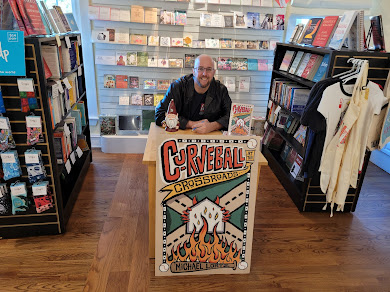
After brunch with one of my old professors, I arrived at the bookstore near 2pm. The signing was scheduled for 2:30, but I wanted to get there early in case we needed to set up. We didn't do a reading, a Q&A, or any other audience participation. I was set up with a chair, a table, and several copies of my book.

People were already there waiting for me before I arrived. Parents of a longtime friend had come in his place as he currently lived out of town. They bought two copies of the book, one for him and one for themselves. Besides my friend's parents, my old professor joined me, as well as several other old friends, some of which I hadn't seen in nearly 15 years. There was a steady stream of guests saying hello and buying my book from the bookstore. I would say my first official bookstore event went very well.


After the signing, my friend and I ventured a short ways out of Tallahassee to the Bradfordville Blues Club. The BBC is one of the best places in America to see live music. It is an old juke joint along an old dirt road where blues legends of yesterday, today, and tomorrow mingle. There is a long history to the Bradfordville Blues Club, and the love and respect the current owners have for the legacy is palpable.

What I did not know until recently was that a large grass field aside the Bradfordville Blues Club was once a baseball field. This discovery will be its own essay eventually, but whereas the BBC was an influence on Curveball at the Crossroads before, now Curveball at the Crossroads could almost be called a literary tribute to the Bradfordville Blues Club. 

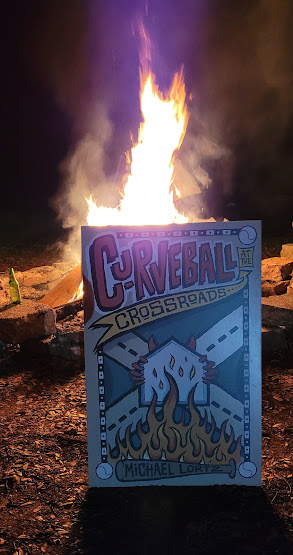
With this new knowledge in mind, my friend and I took several pics of my Curveball at the Crossroads poster around the Bradfordville Blues Club. The artwork for my book was done by prominent blues artist Mojohand, so naturally the art of the book fit with the vibe of the bar. We also took several pics of the book poster on the old baseball field. Curveball at the Crossroads was in its spiritual home.

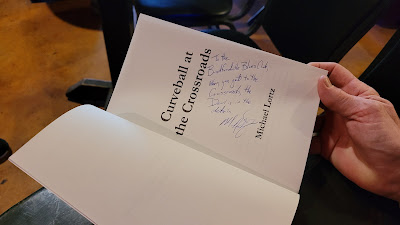
Before I left, I signed a book for the club and gave it to the club manager so he could give it to the owner. It was the least I could do.


After my friend, his girlfriend, and I got dinner, I returned to the Bradfordville Blues Club for the night concert featuring Tampa blues guitarist Selwyn Birchwood. Selwyn has recently become one of my favorite new blues players. Not only is he local, but he is also becoming nationally recognized for his original songwriting and blues guitar prowess. With any luck, he could be the next Robert Cray or Gary Clark, Jr. Don't be surprised to see his name in bigger and bigger places.

As I pulled into the club parking lot, the parking attendant told me to pull to the right of the bar near the band's van. She told me that if I had books with me, they would be cool with setting me up with a table to sell books during the show. I was flabbergasted. Earlier in the week, I messaged the club asking if I could sell books there, but didn't get a response. But they had gotten it and wanted Curveball at the Crossroads there.

Not only did Selwyn put on yet another great show, but I made money before, during. and after the show. I had a table six feet from the stage, right in front of the 200 or so people in the audience. And before the show, the owner of the Bradfordville Blues Club introduced me and my book to the crowd. Within minutes, people started coming up, talking to me, and buying books.

To sell my book at my favorite blues club was an unbelievable experience. 

Following a phenomenal Saturday night, I kept the blues and baseball vibe alive Sunday by attending a Florida State University baseball game. The weather was perfect, the field was pristine, and the sound of the ball pinging off the bat filled the air. There is no better daytime activity on an early spring day in North Florida than watching baseball. Of course, it always helps that the Seminoles won.

When the game was over, I drove to my friend's house, joined them for dinner, said farewell, and embarked on my return journey to Tampa. It was a perfect weekend of books, blues, and baseball.


Monday, May 13, 2019

The Tall Tale of Rube Bellweather


The tradition of avoiding pitchers during their throwing of a no-hitter started in the 1890s when a pitcher named Rube Bellweather of the Atlanta Confederates refused to shower while he was doing well. During a lengthy streak of success, Bellweather’s odor began to wear on his team. No one said anything, however, as he continued to pitch well and the team continued to win.

During one game, the odoriferous Bellweather was particularly effective, holding the opposing team without a hit through seven innings. As it was a typical Atlanta day, with the temperature well over 90 degrees and a stifling humidity caressing the air, Bellweather’s body odor was too much to bear for his teammates. When in the dugout they purposefully avoided him, staying to one side or even leaping the barriers and sitting with the fans to watch their teammates at bat.

Unfortunately for Bellweather’s teammates, they had trouble of their own at the plate as the opposing pitcher also held them hitless through eight innings. After a scoreless and hitless ninth, tenth, and then eleventh innings, and a growing gross aroma permeating from Bellweather, his team decided to take matters into their own hands. In the bottom of the twelfth inning, Bellweather’s teammates pulled a defensive mutiny on the pitcher, dropping fly balls, kicking ground balls, and throwing the ball all over the field until three runs scored.

But the bottom of the twelfth brought positive tidings for the hometown nine. After quickly getting two outs, the opposing hurler hit the next two Atlanta hitters and issued a walk to load the bases. Bellweather himself strode to the plate with an odor so raunchy neither the umpire nor the opposing catcher could look in the direction of either the pitcher on the mound or the pitcher at the plate. Fortunately, they needn’t hold their breath nor watch the action for long. Bellweather swung at the first offering and hit the ball far beyond the outfield field fence for a game winning grand slam. In honor of Bellweather’s heroics and his teammates’ poor actions, the tradition of avoiding a pitcher while he is throwing a no-hitter continued.

Sunday, May 5, 2019

Detained by Stormtroopers in Clearwater, Florida


I recently acquired Jedi robes. I bought them from an ancient dealer of fine attire in the cyberspace realm of the Amazon. They have served me well. Although not a Jedi, I do consider myself strong with the Force. Due to the cost of the Jedi Academy, I could never afford to be properly trained in the art of the Jedi. And now I am too old to begin my training. But wearing the robes of the Jedi is to me akin to wearing the sports jersey of my favorite team. I am showing my support to the cause.

So it was apropos that I wear my Jedi garb to Star Wars Night at the Clearwater Threshers baseball game. It was a fun night at the ballpark, good food, good people, and a great fireworks show.

Until I was detained. Apparently, Clearwater is under the rule of the Empire and had the 501st Legion patrolling the premises, looking for Jedi. Luckily, they let me go. I may or may not have used an amateur Jedi mind trick on them.

I'm glad I didn't bring the lightsaber I acquired on the moon of Ord Mantell.

Monday, July 17, 2017

My letter to late Mets pitcher Anthony Young


A few weeks ago, former New York Mets pitcher Anthony Young passed away. Several baseball websites discussed his death and career, from Fangraphs and their statistical analysis to Faith and Fear in Flushing and their insightful look at emotional connections to Mets players, times, and spaces.

Anthony Young was unique. He played at the top level of Major League Baseball but held a record no player should ever want - most consecutive losing decisions. Young lost 27 games in a row from 1992 to 1993. His career record was 5-35. Based on that, Anthony Young was one of the worst pitchers in Major League history.

But AY's personality, determination, and grace under the circumstances never showed signs of a loser. Who AY was helped show people that losing in baseball was far too subjective. A player could do well, but throw one misplaced pitch, could be branded a loser.

Baseball, like life, is rarely fair.

Personally, Anthony Young was one of my favorite players in the early 1990s. Not only because he pitched for the Mets and I was a Mets fan, but on a human level, I related to AY.

I was never a born winner. Especially athletically. I was typically on the Little League teams that struggled to win one game a year. For several Little League years, I was a pitcher, and struggled not to get upset when a teammate threw to a wrong base or failed to catch a fly ball. I might not have been an all-star, but I always thought I deserved a little better.

Following my Little League years, I played countless games of pickup baseball on my block. Mostly against my friend from the adjacent subdevelopment. We used a tennis ball, a pitchback for a backstop, and automatics to determine the type of hit - weak groundballs were automatic outs, flyballs past a light pole were a home run. The end of my block was our field and we had a mutual understanding of the ground rules.

There were no fielders and no teammates to point the finger at. I pitched and I hit. If I did neither well, I lost.

I lost often.

(From what I hear, kids today don't play street baseball like this any more. Of course, there is video game addiction, but beside that, kids are told not to pitch as often as I did. Maybe I burnt out too quick. Maybe I could have been a left-handed relief pitcher in the Majors. I guess I will never know.)

My friend and I would play every day all summer. He was stronger and threw harder. I lost at least 50 in a row.

Then, on one lazy summer day, I won. If I remember right, the score was 2 to 1, or maybe 1 to 0. I never scored many runs, but on that day, I had my friend off-balance with a mix of well located average fastballs and decent change-ups. I might have even tried to slip in a bad slider or a forkball.

Regardless of the mix of mediocre offerings, I won. And it made my summer.

With the Mets mired in their own malaise and Anthony Young's win total still stuck on zero, I wrote AY a letter. I told him if could win on the streets of Melbourne, Florida, I was sure his day in the sun in New York City would come eventually.

Being the fan I was, I included an early '90s Topps baseball card and a safe-addressed stamped envelop with my letter. At the end of my letter, I asked AY if he could sign my card and send it back to me. He did.

(Looking back, that seems like an awkward request. Hey, best of luck, I'm rooting for you. Can you sign this card and send it back to me because I sent you best wishes?)

A few weeks after my card arrived, Anthony Young got a win over the Marlins, finally breaking his dubious losing streak. Amidst the voodoo dolls, good luck trinkets, and other knick-knacks AY received from Mets fans with the intent to change his luck, I like to think a letter of encouragement from a fellow struggling pitcher had a small part in helping him remove the zoo from his back.

Friday, June 16, 2017

I made a good tweet

I've been on twitter for about eight years. I have a little over 1,000 followers. I'm not a big time social media star. I tweet about the wide array of things that appeal to me or catch my eye.

A few people respond to me regularly, and I reply back to them.

Only three times in eight years have my tweets been circulated to the masses.

The first was a picture of me in an R2D2 costume from 1982. I tweeted that to @StarWars and they retweeted it to the rest of the galaxy.

The second time my tweet was heavily circulated was when I posted a Chuck D song about Muhammad Ali after Muhammad Ali died. Chuck D retweeted that to all the Public Enemy fans worldwide.

So it usually takes someone popular to push my tweets to the masses.

Last week, however, after New Jersey Governor Chris Christie called President Trump's tone to the ex-FBI director "normal New York City conversation", I posted this:


As you can see, a lot of people interacted with this post. I was shocked. Granted, it's not millions or thousands and I am not asking for free nuggets, but nearly 200 retweets and over 600 likes for a joke isn't bad.

My theory is that the tweet jumped in popularity when Twitter posted it on their top tweets for the topic. If you went to the twitter home page, there was a headline of "New York City conversation". Clicking the headline brought you to dozens and dozens of tweets about the subject. As mine was pretty popular, it rose to the top, which then made it more popular. Twitter is weird like that.

So that's my most popular tweet to date. Mr. Met engaging in a normal New York City conversation.

Thursday, September 8, 2016

Guest posting on Ben's Biz


I've been an e-migo and reader of Ben Hill of Minor League Baseball.com for several years. Ben has been writing for Minor League Baseball covering promotions for a long time. It's been his niche for at least five years. He is a regular on the Minor League circuit, traveling from ballpark to ballpark, meeting and writing about the kooky craziness that is the Minor Leagues.

Seems like forever ago my colleagues at Bus Leagues Baseball.com interviewed Ben. Although Bus Leagues Baseball closed years ago and most of the writers moved on, I stayed in touch with folks with our subjects. One of the reasons I like to stay in touch is to pitch writing ideas if the urge catches me. This way, even though I don't cover the subject regularly, I can still write a piece on something I am concerned about.

Sadly, the most recent subject I was concerned about was the end of the Brevard County Manatees. I've written about the Manatees a lot on this and other blogs. They were the local Minor League team in the town in which I spent most of my teen years.

Starting in 2017, however, they are moving to Kissimmee, Florida to become the Central Florida Somethings. It doesn't matter to me what they become, I won't be going. To me they will always be the team I saw for 23 seasons. The team I saw with my dad, with friends (to include a highly impromptu bachelor party), with my brother, and with my nephew.

They are the team Ben Hill let me write about one last time in a post entitled "Farewell to the Sea Cows".

If you are a fan of Minor League Baseball, I recommend you check it out.

Long live the Fighting Sea Cows.

Thursday, July 31, 2014

Portrait of Young LOOGY


I've often written about my early days on the ballfield. Days where I was the Jamie Moyer of the Eau Gallie Little League - a junk-balling control specialist with a a good change-up and an uncanny ability to locate my league-average fastball. Up and down, in and out, I kept the other 12-year olds off-balance.

Facebook is funny sometimes. Amidst the pics of high school classmates' kids and vacation selfies of still-single friends, sometimes a nugget of memories emerges. Two weeks ago, one of my old little league teammates posted a "Throwback Thursday" pic that took me by surprise.

I played in the Eau Gallie Little League from ages 10 to 14. So this was my second to last year. If I remember right, this team won a few games. I pretty sure I pitched a game or two. I know I played a lot of right field in those days.


These days, my 6-year old nephew plays on the same fields I played on. He's also left-handed. If he stays with the game, I hope he does better than I did.

He already hits a lot better.

(By the way, if you couldn't tell, I'm the kid with the glasses in the left end of the front row.)

Monday, April 28, 2014

What do Tampa people support?

Since I've lived in Tampa, I've checked out several local entertainment scenes:
  • Baseball - Major League and Minor League
  • Pro Wrestling
  • Stand-Up Comedy
  • Hip-Hop
  • Heavy Metal
There are many other scenes throughout Tampa, but these are the ones I can say I know fairly well. Either I've participated or gone to see them often. While these scenes have similar demographics, they also have something else in common.

Lack of Support

Of these, the hip-hop scene probably has the best support. Especially if a national act is involved. If a known entity is performing and local acts are opening, a venue can expect to be sold out or close to it. But without a national act headlining, many local rappers and DJs end up playing for themselves.

The lack of support for baseball has been well documented, especially at the Major League level. Sure, there is a bevy of reasons, and the Rays TV ratings are great, but too often cheers echo in stadiums throughout the Tampa Bay area. Especially in the Minor League parks.

Pro Wrestling used to be huge in Tampa. Back in the day, Tampa was a hotbed of wrestling, where legends such as Dusty Rhodes ran the state. Not only did they pack the Hester Armory near downtown Tampa, but occasionally they even sold out major football stadiums. Now the WWE moved its training to Orlando and the only pro wrestling that performs regularly is the occasional bar show in Ybor City.

The local stand-up comedy scene can be better supported as well. While the Tampa Improv and Side Splitters bring in some great national acts, local comics plying their trade appear in front of 25-50 people at best at open mic and small performances. Sure, Tampa is not on the list of "funniest cities" and I personally need to get on stage more, but when more people come out to shows, more people are motivated to perform and join the scene. That is how communities grow.

As for Heavy Metal, admittedly, I don't know as much as I would like to. I am probably guilty of lack of support. I go to shows, but only when big bands are in town, bands such as Obituary and Cannibal Corpse. I do go to the metal community's annual fundraiser for spaying and neutering stray cats and that is usually a great show packed with the best of Tampa Bay metal. But I could probably do more.

Recently, I have been reading Tampa Metal Review.com, a website that writes about the local metal scene. They do good work interviewing bands, taking pics, and reviewing shows. Last week, however, one of their writers called out the scene for not supporting local bands.
There were probably 40 people there the ENTIRE time! Do you people not realize that we are fortunate enough to see bands like this on a pretty regular basis where as in other parts of the USA even (not including the world) would pay $$$$$ to get in the door to see them?!?! We are talking 10$ and 6$ to get in the door. You can’t save up enough change through the week to come see a band line up like this one? I am a poor college student and I can even do this. And do not tell me Behemoth took all your money either. I truly believe there is a lack of support for bands. I have seen a decline over the past six years and frankly, it turns my stomach. You wonder why these bands bitch? No actually, most of them don’t because they will play for ashtrays anyway because they LOVE what they do!
Playing for ashtrays. I've never heard that before. I like it. I might have to use that one.

I've been in Tampa for eight years and I'm still not sure what the people of Tampa do support. Maybe they (we) just wait for the next big show or event. Maybe the majority of us don't want to bother with local acts and want to see only the brand names.

Tampa isn't known for much nationally. Our high school baseball teams are usually good and we have had dozens of Major Leaguers hail from here. Our metal scene is highly regarded, and some of the best in Death Metal have recorded, if not started here. But both of these scenes suffer from lack of support.

At least we support our local beer makers. We are getting good at that. Too bad our politicians might burst that bubble on us.

But that's a whole other issue.

Saturday, March 22, 2014

My new labor of love

It's been awfully quiet here lately. Tragically quiet. One might think I am trying to commit blog suicide. I swear I am not.

The reason this blog has been so barren of late is because I started a new online endeavor. I bought a new site domain and everything. And since February 1st, I've posted over 40 times there.

So I've been writing. A lot. And doing quite a bit of math and statistical analysis there as well. The type of stuff that just doesn't jive over here.

So far, Tampa Bay Baseball Market has been a success. I have gotten a lot of positive feedback by some really smart people. People are digging my deep-dive into the wonderful and wacky world of the Tampa Bay Rays attendance. Of course there are some who think I will find some magic panacea for why plagues the Rays attendance. There are not going to be happy.

There is no magic bullet theory.

What plagues Rays attendance is a lot of little things - from location of the park to who they are playing to day of the week to traffic to many other things. The whole thing is a paradox folded in a conundrum squashed in a dilemma. It's not easy and it is requiring a lot of work.

Hence I haven't been here filling these pages with witty banter.

In other news, I am starting to write query letters to get my first fiction book out published. I need to get that done. The book has been sitting semi-complete for too long. And I think people will enjoy it.

Add that to the list of things I am doing. Along with school (finance kicked my butt!), looking for a job, and other creative endeavors. I need to get comedy on that list as well. I miss going to the Tampa Improv for open mics. I miss writing creatively, shooting for humor on occasion.

I miss writing here.

Never fear, dear long time reader, I will have more posts soon. This month will not set the record for fewest posts. Even if it is a link dump of stuff I find interesting, you will get something here.

I promise.

Sunday, April 21, 2013

Book Review: The Catcher Was a Spy: The Mysterious Life of Moe Berg


As I have mentioned before, I am a fan of media that combines two or more of my interests. If you make a heavy metal song about Star Wars, I'll listen. If you write about hip-hop in Senegal, I'll read it. This wide array of interests usually makes it easy for people to find things I'll like. I'm not hard to buy for.

Knowing my fan interest in baseball and my professional interest in military intelligence, a few friends included "The Catcher Was A Spy: The Mysterious Life of Moe Berg", a book by Nicholas Dawidoff, in a care package I received last summer. It was a very good call.

I had heard of former baseball player Moe Berg before. I remember reading a magazine article stating he worked for some high-level intelligence agencies during World War 2. Turns out, that magazine article, from Sports Illustrated, was also written by Dawidoff. The Catcher Was A Spy expands on the article and provides results from years of researching perhaps the most mysterious man in baseball history.

According to Dawidoff, Berg filled many roles during his life. He was at one time or another, a student, lawyer, linguist, sightseer, vagabond, advisor, babysitter, consultant, investor, writer,  and of course, catcher and spy. Dawidoff weaves each of these titles into an interesting story, while attempting to reveal the secrets Berg kept from many people he knew.

In the beginning chapters of the book, Dawidoff discusses Moe Berg's professional baseball career and his baseball life intersected with his academic interests. In a nutshell, after a distinguished college career at Princeton, Berg did little at the big league level. A quick aside look-up on Baseball-Reference.com lists him as the 15th worst baseball player with a minimum of 500 games. That's bad. But yet Berg hung on, playing over 75 games three times in a 15-year career. Dawidoff stipulates that Berg's closeness with front office management allowed him to take up a roster spot that might be better given to a minor leaguer.

But although Berg wasn't playing, he was getting smarter. Which according to Dawidoff, is one of the overarching themes of the book. During the baseball chapters, Dawidoff writes about Berg's dalliance with law and business, and how Berg would wow his teammates and coaches with stories and facts few athletes took the time to learn. Dawidoff does state that Berg was also knowledgable of his craft,  so much so that he became an impromptu coach during his last few seasons.

The conclusion of Berg's baseball career in 1942 ends the first part of The Catcher Was A Spy. The second part of the book details as best as possible Berg's work with the Office of Strategic Services (a precursor of the CIA). Through an index full of library research and interviews, Dawidoff pieces together Berg's travels through Europe during WWII and his attempt to acquire as much information as possible about a possible German nuclear or atomic bomb. Here the names sometimes blend together as Berg travels from country to country talking to nuclear scientists and other scientifical types. Dawidoff also writes about Berg's interactions with various intelligence personnel in the OSS, US military, and other branches of government.

By the conclusion of the very lengthy chapter on Berg's spy career, the reader is given the impression that although Berg did some good work, he thought too highly of his own worth. The impression is that Berg believed he was the best spy the CIA had, and could hence run up expense accounts and travel willy-nilly as he wanted, as long as he met with an interviewee on occasion. Dawidoff quotes other intelligence personnel who state that Berg wasn't as big of a deal as he thought himself.

Although this chapter is nearly 50 pages and Dawidoff did what he could in his research, my question is "is that all?". Was all of the Berg information declassified prior to or for the purposes of this book? What information did the CIA or other government organizations not let Dawidoff see? Would they have changed the reader's perception of Berg? Did he do anything greater or more important to national security than what is already mentioned?

Following discussion of Berg's war service, Dawidoff attempts to detail Berg's transformation into an itinerate wanderer. According to Dawidoff, Berg bounced from house to house, taking advantage of friends' kindness and compassion. Dawidoff hints at some awkward moments that give the reader the impression that Berg was a bit social inept, from the story of Berg tickling a little girl alone in a darkened room to Berg's fascination and desire to cling to friends and associates suffering from tragedy.

In the final chapter of the book, Dawidoff tries to piece together Moe Berg. Dawidoff comes to the conclusion Berg was an outsider, unable or unwilling to connect with people in a "normal" sense. Dawidoff suggests Berg's idiosynchrisies derive from his attempts to impress his father, a man who never believed Berg should pursue baseball but should stay in more honorable pursuits. Dawidoff also stipulates Berg suffered from a lack of importance after World War II and set himself adrift, successfully floating until the day he died.

With nearly a 70-page bibliography, The Catcher Was A Spy is an incredibly well-researched book. Is the mysterious Berg a subject worth the research? For sure. Berg was neither a Hall of Famer or a real-life James Bond. But he was was one of the most interesting people to ever play professional baseball and work for the CIA. Thousands of people have done one of the two. Only Moe Berg did both.

Tuesday, April 10, 2012

Ghost Stadiums - Cocoa Expo Sports Complex, Cocoa, Florida


(This post originally appeared on Bus Leagues Baseball.com)

Before I left for Afghanistan in mid-March, I drove across Florida from my home in Tampa to my parents’ home in Melbourne. Along the way, on Florida State Road 520, just outside of Cocoa, Florida, I saw the remains of what was once the home of the Florida State League’s Cocoa Astros, the spring home of the Houston Astros, and for a season, the spring home of the then-Florida Marlins. Sadly, even at 55 mph, it was apparent the Cocoa Expo Sports Complex had seen better days.

Built in 1964, the Cocoa Expo Sports Complex was designed to host baseball, soccer, and other sports on its outdoor fields; basketball, volleyball, and other indoor sports in its indoor complex; and events such as the Florida State Fair in its exhibition hall. The 40-acre complex was supposed to be the premier multi-use event center in Brevard County.

And for many years it was. Shortly after the facility opened, the Houston Astros moved from Apache Junction, Arizona to the Cocoa Expo Sports Complex for spring training and made it the new home of their Florida State League affiliate, the Cocoa Astros. In 1972, the Cocoa Astros moved to Dubuque, Iowa, then to Cedar Rapids, then came back to Cocoa in 1977, before moving throughout Florida from 1982 to 2000 and then finding their current home in the Carolina League as the Lancaster Jethawks.

In 1985, the big league Astros joined their minor league affiliate in departing the Cocoa Expo Sports Complex when they claimed the facility was “rundown” and told the City of Cocoa to pay for the renovations. After the city balked, claiming renovation had to be paid for by the Astros organization, the City of Kissimmee swooped in and lured the Astros and their minor league team an hour west.

After the Astros moved, a private ownership group bought the Cocoa Expo, put their own money into fixing it, and hosted various professional baseball-related events such as the Joe Brinkman Umpire School (1985-1998) and and an academy run by former Brevard County standout and current Major League manager Clint Hurdle. The facility also continued to host many amateur events.

On a personal note, I had a chance to play in one of the many amateur events during my final year of Little League in 1992. A few weeks after our season was over, my then-coach called to ask me if I wanted to participate in an exhibition against a team of traveling Brazilian teens. Never one to turn down the ability to play, I accepted. Although I don’t remember the final score, I remember the Brazilian team being very good and their pitcher throwing very fast, faster than most American kids my age. If I remember correctly, I went 0 for 2 with a strikeout and ground out.

A year after I played there, the Cocoa Expo Sports Complex hosted to its final professional baseball team. In 1993, the then-Florida Marlins played their first season in the Grapefruit League at the Cocoa Expo as they awaited the completion of Space Coast Stadium. Unlike the Astros however, the Marlins only used the complex for its stadium as they practiced and worked out in neighboring Viera adjacent to Space Coast Stadium on the fields of the Carl Barger Complex. Following the Marlins temporary residence, the complex still hosted amateur baseball, basketball, volleyball, and soccer tournaments, gun shows, and the state fair.

Unfortunately, time and the poor economy caught up to the Cocoa Expo Sports Complex. According to recent reports, in June 2011 the complex was foreclosed and seized by its main lender. After months of vacancy, with chains and locks and a sign announcing the foreclosure on the gates, new owners bought the complex and began $40 million dollars in repairs with the intent of making the complex a destination for amateur baseball, basketball, and volleyball teams from around the country. The new ownership attempted to open parts of the complex in March 2012 for a baseball tournament, but faced a wide array of complaints that the fields and facilities were unsafe and that the venue was “an open construction site”.

Will there ever be professional baseball at the Cocoa Expo Sports Complex again? Highly doubtful for three reasons. First and foremost, that doesn’t seem to be the intent of the new ownership. Second, while the complex might one day be suitable for college and amateur training and showcases, the main stadium needs far too many improvements to be considered a viable Florida State League destination. And third, and with Space Coast Stadium, home of the Brevard County Manatees since 1994, only 15 minutes south on I-95, I doubt there is any interest from a Minor League Baseball to place another team in the area.

Professional baseball history is also not on the side of the Cocoa Expo Sports Complex. Only once since 1941 has more than one team called Brevard County home. In 1972 the Cocoa Astros were joined by the four teams of the Florida East Coast Rookie League teams, the also-named Cocoa Astros, the Cocoa Expos, and the Melbourne Twins and Melbourne Reds. After one season, the Florida East Coast Rookie League folded and was never heard from again.

With their recent black eye and bad press, the new ownership of the Cocoa Expo Sports Complex might want to wait until the renovations are completely finished before opening the facility to the public. Until then, however, the Cocoa Expo Sports Complex will be devoid of all baseball and sit as a sad decrepit reminder of Cocoa, Florida’s minor league past.

Image acquired from ballparkreviews.com.

Monday, January 2, 2012

Is there baseball in Afghanistan?


Hey folks, I have a big announcement:

My job is sending me to Afghanistan for a year in late January / early February.

After being unemployed for most of 2011, I decided to take a job in Afghanistan for a year. So after I take my physicals, get my shots, do my paperwork, and learn my job, it is off to the vast unknown.

While I am there I will still try to write, but I am not sure how close I am going to be able to follow baseball in America. I'll try to do some interviews if at all possible - maybe I can email people some questions and post their answers here. Maybe I can find people who are playing baseball in Afghanistan and talk to them. A quick google search on "Afghanistan baseball" brings up articles on baseball being played in Afghanistan as early as 1946, baseball currently growing in popularity in Afghanistan, Army soldiers teaching Afghans baseball, the South Asian Baseball Tournament between Afghanistan and Pakistan, and other Americans keeping their baseball love strong by playing at bases thousands of miles from home. So there should be some interesting subjects to write about.

But I won't be going to any games until Spring Training 2013.

Wow, that seems so far away, since we aren't even in Spring Training 2012. But by the time the 2012 World Series finishes and the season is officially over, I'll only have a few months left. The way I see it, following baseball will get me through to November, then Thanksgiving, then Christmas, New Years, then I'll be counting down the days on my fingers and toes.

Baseball history is full of players who travel and come back more successful. A few examples include Cecil Fielder, Orestes Destrade, and current Ranger hurler Colby Lewis. For these players, their time overseas helped them focus, seize their potential, and become better ballplayers. My goal is to do the same with writing. Along with the possibility of emailing Q&As, I also have some short stories I want to finish during my time away. Even though I will be out of the loop, I refuse to get rusty as a writer. With not much else to do besides work, I would be foolish not to take the time to improve my craft.

Another one of the benefits of going overseas for a year is the pay and the fact that I won't be spending anything in regards to bills for a year. Perhaps I will do a trek of minor league parks when I return. We'll see.

Monday, December 5, 2011

Bus Leagues Experience Volume 2 is now available


(This post originally appeared on Bus Leagues Baseball.com)

We are happy to announce the release of our second annual book: The Bus Leagues Experience Volume 2.

Like our first release, The Bus Leagues Experience Volume 2 is a collection of interviews and conversations with some of the brightest prospects in Minor League Baseball as well as coaches, media personnel, fans, and other people associated with the lower levels of professional baseball. Volume 2 expands on our original work by featuring the voices of our expanded roster of writers and includes much of the work Brian and Mike did during their tenures with MiLB.com.

We worked hard to ensure The Bus Leagues Experience Volume 2 is available for the holidays. We promise it will make a great gift for baseball fans of all ages no matter what their holiday or denomination.

Again, we would like to thank each and every one of you for your support, without of which this book would never be possible.

Click here to buy The Bus Leagues Experience Volume 2 at Amazon.com.

The Bus Leagues Experience Volume 2 includes interviews with the following:

Travelers & Fans

James Dively

Tug Haines

Joe Price

Torianne Valdez

Craig Wieczorkiewicz

Writers & Broadcasters

Bruce Baskin

Clark Brooks

Jim Donten

Kurt Schweizer

Greg Young

Players

Dellin Betances

Tiffany Brooks

Chris Cates

Travis d’Arnaud

Wes Etheridge

Anthony Gose

Mark Hendrickson

Liam Hendriks

Chad Jenkins

Mike McDade

Mike Minor

Stolmy Pimentel

D’Vontrey Richardson

Moises Sierra

Michael Spidale

Zach Stewart

Kyle Weiland

MiLB.com

Stetson Allie & Justin Meccage

Aaron Altherr & Mickey Morandini

Garin Cecchini & Rich Gedman

Alexander Colome

Cito Culver

Jarek Cunningham

Matt Hobgood & Scott McGregor

Kyle Jensen

Coline Kaline

Jeff Locke

Richard Lucas

Matthew Neil

Matt Rice & Kes Carter

Garrett Wittels

From the Podcast

Jackie Bradley Jr.

Jeff Perro

George Springer

Thanks!