Showing posts with label Blues. Show all posts

Tuesday, January 20, 2026

Book Review: Beyond the Crossroads - The Devil in the Blues Tradition by Adam Gussow


With the release of the blockbuster movie Sinners, Beyond the Crossroads is a must read for anyone who wants to know the story beyond the story. Gussow thoroughly dissects the use of the term Devil in blues music from the earliest days before Robert Johnson, through Johnson's career, through the movie Crossroads, and into the 2000-era explosion of blues tourism in Clarksdale, MS. The book is split into several essays exploring the aspects of the devil and his association in the blues. Even though I thought I knew a lot about the subject, I learned a lot. Gussow is very, very thorough.

That said, Gussow writes like an academic. It almost too thorough. Beyond the Crossroads is not a quick read. The comparative theories and analysis create drag in the narrative. This is a book for the hardcore fans and academics, not for the casual blues fans. Even though the casual blues fans are the ones who probably need to read it.

Monday, October 30, 2023

Book Review on Suncoast Blues Society webpage


I wrote a book review of the book Up Jumped the Devil: The Real Life of Robert Johnson over at the Suncoast Blues Society blog.

Book Review: Up Jumped the Devil: The Real Life of Robert Johnson - Suncoast Blues Society blog, 10/10/23


Monday, June 6, 2022

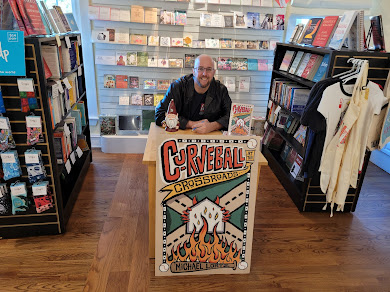
Returning to the Crossroads and Selling My Debut Novel


In 2009, I took a trip to the Crossroads in Clarksdale, Mississippi. I journeyed there after five days in Memphis with no plan and no idea what to expect. As luck would have it, I arrived during the Sunflower River Blues and Gospel Music Festival. I had the pleasure of not only exploring Clarksdale, but also seeing some great local bands and meeting some great local people. Clarksdale was one of the highlights of that great adventure.

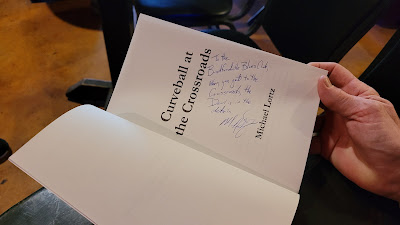
Thirteen years later, I finally returned to the Crossroads. This time, I brought my debut novel, Curveball at the Crossroads, which was highly influenced by my first trip to the Mississippi Delta.

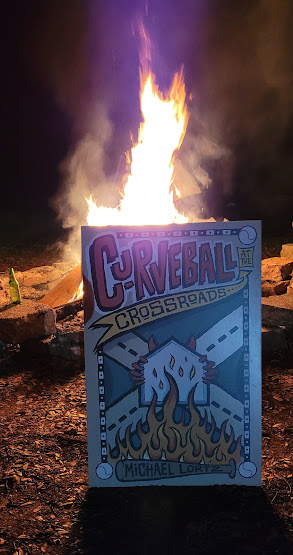
I published the 2nd edition of Curveball at the Crossroads in November 2021. One of the biggest changes between the first and second edition is the new cover designed by famous blues artist Grego "Mojo Hand" Anderson. Grego was great to work with and did an amazing job capturing the essence of the book in the new cover. Best of all, I was able to piggyback on Grego's reputation to open more doors for the book. 

One of those doors was with Roger Stolle, owner of Cat Head Delta Blues Folk Art Store in Clarksdale. Roger carries a lot of Grego's art, so I knew Cat Head would be a logical fit for my book. After emailing Roger and sharing news of Curveball at the Crossroads, Roger agreed to order copies of my book and we discussed a possible book signing. He recommended I visit during the 2022 Juke Joint Festival. After looking up the event, I quickly bought my plane and event tickets.

Not only was I visiting Clarksdale again, but I was also having my first out-of-state book signing. 

To make things better, Clarksdale is Curveball at the Crossroads' spiritual home. I believe every book has a spiritual home. It could be the author's home, but it might not be. It might also be where a scene of the book takes place, but it also might not be. A book's spiritual home is the place that inspired the book. For example, if a visit to medieval castle inspired me to write a wrote a fantasy tale of knights and elves that took place in an imaginary kingdom, then that real life castle is my book's spiritual home. Although Curveball at the Crossroads takes place in Rosedale, Mississippi, Clarksdale is definitely its spiritual home.

Because I booked so late - I did not realize hotels for the Juke Joint Fest fill up a year out - I ended up in an Airbnb about an hour away in small Como, Mississippi. According to wikipedia, Como has a total area of two miles and is home to 1,200 people. Much smaller than my current home of Tampa, Florida.

Despite of, or perhaps because of its size, Como was the perfect place place to stay. It was quiet, it was serene, and my host and the guest house I stayed in was amazing. Couldn't have asked for a better place, even if my drives back from Clarksdale along Mississippi's dark, two-lane highways were kinda creepy. But that's part of the fun, and who knows, it might be the inspiration for another book or at least another scene.

I arrived in Mississippi on a Thursday afternoon. After checking in and unloading my bags, I drove to Oxford, Mississippi, home of the University of Mississippi and, more meaningful to me, Square Books, one of the most famous independent bookstores in the Southeast.

Square Books was everything I thought. A cozy, two-story bookstore in the middle of the town square, Square Books had a perfect mix of current best sellers and regional authors. After giving them a copy of Curveball at the Crossroads to sample, I bought a small pile of new books for my own collection. With luck, they will like Curveball at the Crossroads and I will be making a return trip to Square Books soon.

After grabbing a beer at an Ole Miss bar and eating dinner at a southern diner, I returned to Como to plot my weekend in Clarksdale. My book signing at Cat Head in Clarksdale was scheduled for noon, so I knew I had to leave early and get up even earlier. So after planning and plotting, and getting some new reading done, I called Day 1 of my adventure a success and went to sleep.

I woke up the next morning, ate breakfast, got ready, said hello to the horses outside the guest house, and headed down to Clarksdale. Not knowing how busy Clarksdale or Cat Head specifically would be or the parking situation for the festival, I arrived an hour early. Although I got a good parking spot a short walk from Cat Head, Clarksdale was already buzzing. Bands and bluesmen were already playing and tourists were already milling about, buying t-shirts, festival programs, posters, and other blues memorabilia.

Clarksdale is not a very big town. Bigger than Como, but not very big compared to other metro areas. Downtown Clarksdale, home of the Blues Museum, the Ground Zero Blues Club, Cat Head, and several juke joints, is only a few blocks. But due to a decline in the national and regional economy, Clarksdale relies on its music festivals to generate revenue. Even though the Juke Joint Festival wasn't officially starting until Saturday, there were already several vendors and food stands on the streets of downtown Clarksdale. And wherever a performer could fit, there was someone playing the blues. They played in front of stores, in stores, on corners, on the railroad tracks, and even on the back of trucks. Live music was everywhere.

After briefly checking out the scene, I walked into Cat Head. Roger was already busy, but found the time to set me up in a front corner of his store. He had several copies of my book already in his store, so I grabbed all his copies for my table. I also brought several copies signed by cover artist Grego "Mojo Hand" Anderson.

Within five minutes of setting up, the first customer walked to my table looking to buy a book. When he saw I also had two Curveball at the Crossroads posters that I was using for the table, he offered to buy one of those as well. First customer, first sale. Also sold a poster to boot.

Customers ebbed and flowed through Cat Head for most of the early afternoon, perusing the shelves, checking out the wares, and for many, walking to my table to see what I had to offer. Within the first hour, I sold the copies Mojo Hand signed and was running low on the other copies. Over ten books were gone in the first hour. I was excited.

By the end of the second hour, I was out of books. Every copy Roger had in his table of books was sold. People were excited to talk baseball and blues. Among the customers who visited my table was Michael Kinsman, head of the San Diego Blues Festival. Michael and I talked about future orders and his idea of presenting the book to prominent blues media writers he knew. Not only did he buy a book, he wanted more to share with others!

All in all, it was a fantastic book signing. I did not expect to sell out. Even Roger admitted maybe he should have ordered more. But, on the other hand, two hours is a good amount of time for a book signing. I had the rest of the day and the rest of the festival to enjoy.

For the remainder of Friday, I walked the streets of Clarksdale, consulting my festival program on which bands will be in which bars when. I saw some absolutely fantastic acts, from acoustic street performers to full electric bands, culminating with Ted Drozdowski's Coyote Motel. Coyote Motel was blues with a stoner groove. Very cool stuff. In a bit of coincidence, one of their better tunes was called "Josh Gibson", after the 1930s Negro League baseball star. So baseball and the blues started and ended my day.

Driving back to my Airbnb Friday night was another adventure. The roads from Como to Clarksdale formed a square, with Como in the northeast corner and Clarksdale in the southwest. To return to Como, I could go north first, then west, or west first, then north. I decided to retrace the path I took to Clarksdale, heading north first, then west to return to Como. What I did not think about, however, was how dark and lonely those two-lane Mississippi highways were. Rural Mississippi at night is complete darkness. Ain't nothing out there but you, the road, the woods, and graveyards.

I woke up Saturday morning, again said hello to the horses, and drove back to Clarksdale. I started the day seeing renown bluesman Terry "Harmonica" Bean. Terry Bean was a must-see for me. Not only because of his music, but because of his backstory. Back in the 1980s, Terry Bean was a can't miss baseball prospect from the local high school. Legend has it, he could throw over 90 miles an hour with both arms, and was as good a pitcher as he was a hitter. He was the real deal with a ticket to the pros. Then it all came crashing down with an injury to his right arm.

If that sounds familiar, it's because it is the backstory of JaMark Reliford, the main character in Curveball at the Crossroads. Except, whereas JaMark made a deal with the Devil to return to baseball, Terry Bean followed in the footsteps of other family members and became a bluesman. He has been playing the blues ever since, travelling the roads and performing in small bars and juke joints throughout Mississippi. Along the way, he has become an encyclopedia of the region, blessing listeners with stories of how life used to be in the Delta.

Following Terry "Harmonica" Bean, I met with my old friend "St. Louis" Frank Chambers. Frank is another walking encyclopedia. He used to travel from St Louis to Clarksdale regularly until moving permanently to Clarksdale years ago. I met Frank at the Riverside Inn in Clarksdale during my first visit in 2009. The Riverside Inn is a historical landmark that the people of Clarksdale are refurbishing after years of wear and tear. In 2009, I stayed a few nights in the hotel and Frank was a regular in the lobby/lounge, mingling with the visitors and catching up with "Rat", the owner of the establishment. Frank and I connected on Facebook and have been in touch ever since. Although he doesn't go the festivals anymore and age is starting to catch up, he is still as connected and personable as ever. We went to Clarksdale's best (maybe only?) Mexican restaurant for lunch and caught up on the last 13 years.

After lunch, Frank and I went to the Riverside Inn to see how the old place was doing. The inn has seen better days structurally as a tree recently punctured the roof and the wooden foundation needs updating. But because it is a cultural landmark, they are getting grants and donations to fix it up. Although I stayed there during my first trip, I asked if one of the new caretakers for the old place could give me a tour. From Aretha Franklin to Ike Turner to JFK, Jr to Bessie Smith (who died in the building when it was a hospital), the names of people who stayed in the Riverside Inn is long and distinguished.

I said farewell to Frank, left the Riverside Inn, and returned downtown to the Juke Joint Festival. I stopped in the Delta Blues Museum as well as Ground Zero Blues Club. The Ground Zero Blues Club is partly owned by legendary actor Morgan Freeman and his picture graces the wall along with so many other blues and Clarksdale legends. I bounced around for a few more hours, saw a few more musicians, and even returned to Cat Head to buy myself some swag.

By Saturday evening, I had two shows left to see, Terry "Harmonica" Bean again and Christone "Kingfish" Ingram, a 23-year-old blues phenomenon who has already played the White House and won a Grammy. Kingfish was to not be missed.

Although I saw Terry "Harmonica" Bean earlier in the day, there were two reasons why I failed to give him a copy of my book after his morning show. The first reason was because I left before he finished. The second, and more important reason, was because I was out of books. However, in my visit to Cat Head, I saw they had two new copies of Curveball at the Crossroads among the books. So, yes, I bought a copy of my own book to give to someone else. Such is the life of a small writer.

When I got to the Delta Blues Alley Cafe, Terry was setting up. I was able to talk with him for a minute or two and present him with a book. He thanked me and told me that he was the Mississippi equivalent to classic '80s baseball stars Dwight Gooden or Bret Saberhagen. Hopefully we can talk baseball and blues again sometime. 

Terry "Harmonica" Bean's show early Saturday evening was a fun jam, not too dissimilar from his morning show, but with a better crowd. He rocked some John Lee Hooker-style boogie blues and got folks dancing. There was also beer served at the evening show, so alcohol was probably amplifying the audience participation.

But unfortunately for Terry "Harmonica" Bean, his show overlapped with the headliner for the entire festival, the star of the region, the next great blues ambassador, Christone "Kingfish" Ingram. After 30 minutes of Terry Bean, folks started filing out of the Blues Alley Cafe to walk the few blocks to Kingfish's show.

For some interesting reason, the concert coordinators of the Juke Joint Festival decided to set Kingfish up in an old bank, not outside on the main stage of the festival. The bank was a cavernous old building, with the word "BANK" outside, just as you expect an old bank to be in a old southern town. There were a few hundred chairs aligned inside the bank with band's setup along the back wall. Although the building had the frame of a bank, it lacked any of the inside bits and pieces, such as a teller counter, offices, and any other furniture. Perhaps it was biggest empty building in Clarksdale.

Layout aside, when I got there, I found a spot close to the side of the "stage". I was approximately 15 feet from Kingfish's left. So I never saw him head-on, but it was probably the closest I have ever been to a Grammy winner performance.

For those who haven't seen or heard of Kingfish, he is the real deal. Straight from the cast of Buddy Guy and the 3 Kings of the Blues - Albert, Freddie, and BB, Kingfish has the chops and riffs to play the blues the way the legends did. He has been blazing a path through the blues scene with his first two albums, already winning the aforementioned Grammy, being featured on national TV, and playing the White House for the Obamas back in 2015. He is as big a deal as deals come in the blues.

Interestingly, when I was scrolling through my pictures from my 2009 visit, I have a pic of Kingfish playing in a kid's band when he was 10 years old. Now 12 years later, I had a chance to see him again.

Kingfish did not disappoint. He rocked through several of his own songs and many blues standards. Although it was a short show - only an hour - he proved again that he is the future of traditional blues.

After Kingfish's stellar performance, I rolled back to Como, full of all new blues memories. My flight back to Tampa was early on Sunday, so I missed the final day of the 2022 Juke Joint Festival. But from my trip to Oxford, to my book signing, to lunch with an old friend, to closing with Kingfish, my return to the Crossroads was a huge success.


Tuesday, April 5, 2022

Curveball at the Crossroads Book Signing at the Juke Joint Festival


Super excited about this news.

My book is going home. Home to the Crossroads.

I have been wanting to do a return trip to Clarksdale, Mississippi for several years and the publishing of Curveball at the Crossroads is providing the perfect opportunity. I will be signing copies of Curveball at the Crossroads at the Cat Head Delta Blues and Folk Art store in Clarksdale on Friday, April 22nd at noon to 1pm. 

I visited Cat Head years ago and it was one of the coolest stores I ever been to. Now to sign my book there and to be an advertised part of the festival is an awesome feeling. Big thanks to Roger, the owner of Cat Head for being receptive to the idea of me swinging by. And a big thanks to him for already posting Curveball at the Crossroads for sale on his website.

Also, for my book collectors: I will also be selling several copies of Curveball at the Crossroads signed by the cover artist, Grego "Mojohand" Anderson. Mojohand is famous in the blues scene as he has done countless posters, album covers, shirt designs, and anything that can show an image. He is fantastic and highly recommended if you like blues art.

My upcoming trip to Clarksdale will also be my first out-of-state book signing, so that also adds to the significance of the event. It is easy to market my book to my local area, but to have reasons to go interstate and spread the word about Curveball at the Crossroads is a great thing.

I hope to have some great pictures from Clarksdale. Hopefully some with a copy of Curveball at the Crossroads. After all, the Mississippi Delta is the spiritual home of Curveball at the Crossroads. 

Wednesday, February 23, 2022

Books, Blues, and Baseball - A Weekend in Tallahassee


A big part of being an author is selling your book. Some authors don't like that part. I love it. As an extrovert, I enjoy meeting people, I enjoy telling them about my book, and I love it when I complete a sale. 

Which honestly, is kinda weird as I have never worked in sales in my life and I have no desire to. Selling my book as a hobby is completely different from selling a product for a living. Maybe one day my book or books could be my living, but I am not expecting that at this point. This is just fun.

As mentioned in previous posts, my first book signing was scheduled at Midtown Reader in Tallahassee, Florida on February 19th, 2022. Going to Tallahassee was a homecoming for me, as it was in Tallahassee way back in 2001 that I published my first article, a piece on library security sensors for the FSView & Florida Flambeau.

Tallahassee is a four hour drive from my home in Tampa. Tampa is a growing metro area and Tallahassee has seen its share of growth in the last 20 years. But small towns along the state highway to the Florida state capital haven't changed in two decades, probably even longer than that. It's rural Florida, deeply conservative, and very old fashioned. Not much changes along these roads. The Dairy Queen is still where it is, the gas stations are still where they are, the 35 mile per hour speed trap still exists, and the town famous for banning Satan is still just as small. Travelling from Tampa to Tallahassee is like driving through a time tunnel, where progress stands still.

I arrived in Tallahassee on Friday afternoon, just in time to meet with a college student I have been helping with resume and career advice. I remember being a clueless college student, so any help I can give is help I didn't have. I might have had a more stable career with a little guidance, so hopefully I can help someone not face the same challenges I have faced. As well, college students keep me open to new ideas and perspectives. There are new thoughts that having a younger "mentor" is a good thing. They help me as much as I help them.

After a Friday evening dinner, I spent the night at a friend's house. I had to get a good night's sleep for my big day on Saturday.

After brunch with one of my old professors, I arrived at the bookstore near 2pm. The signing was scheduled for 2:30, but I wanted to get there early in case we needed to set up. We didn't do a reading, a Q&A, or any other audience participation. I was set up with a chair, a table, and several copies of my book.

People were already there waiting for me before I arrived. Parents of a longtime friend had come in his place as he currently lived out of town. They bought two copies of the book, one for him and one for themselves. Besides my friend's parents, my old professor joined me, as well as several other old friends, some of which I hadn't seen in nearly 15 years. There was a steady stream of guests saying hello and buying my book from the bookstore. I would say my first official bookstore event went very well.


After the signing, my friend and I ventured a short ways out of Tallahassee to the Bradfordville Blues Club. The BBC is one of the best places in America to see live music. It is an old juke joint along an old dirt road where blues legends of yesterday, today, and tomorrow mingle. There is a long history to the Bradfordville Blues Club, and the love and respect the current owners have for the legacy is palpable.

What I did not know until recently was that a large grass field aside the Bradfordville Blues Club was once a baseball field. This discovery will be its own essay eventually, but whereas the BBC was an influence on Curveball at the Crossroads before, now Curveball at the Crossroads could almost be called a literary tribute to the Bradfordville Blues Club. 

With this new knowledge in mind, my friend and I took several pics of my Curveball at the Crossroads poster around the Bradfordville Blues Club. The artwork for my book was done by prominent blues artist Mojohand, so naturally the art of the book fit with the vibe of the bar. We also took several pics of the book poster on the old baseball field. Curveball at the Crossroads was in its spiritual home.

Before I left, I signed a book for the club and gave it to the club manager so he could give it to the owner. It was the least I could do.


After my friend, his girlfriend, and I got dinner, I returned to the Bradfordville Blues Club for the night concert featuring Tampa blues guitarist Selwyn Birchwood. Selwyn has recently become one of my favorite new blues players. Not only is he local, but he is also becoming nationally recognized for his original songwriting and blues guitar prowess. With any luck, he could be the next Robert Cray or Gary Clark, Jr. Don't be surprised to see his name in bigger and bigger places.

As I pulled into the club parking lot, the parking attendant told me to pull to the right of the bar near the band's van. She told me that if I had books with me, they would be cool with setting me up with a table to sell books during the show. I was flabbergasted. Earlier in the week, I messaged the club asking if I could sell books there, but didn't get a response. But they had gotten it and wanted Curveball at the Crossroads there.

Not only did Selwyn put on yet another great show, but I made money before, during. and after the show. I had a table six feet from the stage, right in front of the 200 or so people in the audience. And before the show, the owner of the Bradfordville Blues Club introduced me and my book to the crowd. Within minutes, people started coming up, talking to me, and buying books.

To sell my book at my favorite blues club was an unbelievable experience. 

Following a phenomenal Saturday night, I kept the blues and baseball vibe alive Sunday by attending a Florida State University baseball game. The weather was perfect, the field was pristine, and the sound of the ball pinging off the bat filled the air. There is no better daytime activity on an early spring day in North Florida than watching baseball. Of course, it always helps that the Seminoles won.

When the game was over, I drove to my friend's house, joined them for dinner, said farewell, and embarked on my return journey to Tampa. It was a perfect weekend of books, blues, and baseball.


Friday, September 3, 2021

Selwyn Birchwood concert at Skippers Smokehouse, Tampa FL


It has been a while since I reviewed a concert on this website. I used write about all the concerts I went to. Over the last few years, I haven't done that as often. Admittedly, COVID-19 shut down the live music scene around the world and there wasn't much to write about, but even before then I wasn't documenting as I was years ago. So excuse me if I am a bit rusty.

I am relatively new to the work of Selwyn Birchwood. Although I read his name in articles and saw it on marques for much of the last 10 years, I never took the time to look him up until I saw his song "Guilty Pleasures" on YouTube. I am a blues stickler/purist and I was super impressed. He had soul, he had a groove, and he nailed the blues.

A few months later, during the pandemic, I saw Selwyn in the background in a large blues tribute show video. I think it might be the BB King Tribute in the Capital Theater, but I am not sure and the videos for that show aren't complete. Regardless of where it was, I said to myself that I better get his music before he gets super huge and too expensive to see live.

In 2020, Selwyn put out a new album, Living in a Burning House. The album contains a song called "Freaks Come Out at Night" (no, not a Whodini cover). The video for this song was filmed at the Bradfordville Blues Club, outside of Tallahassee - one of America's last remaining juke joints and one of my favorite places to see live music anywhere. If I wasn't a fan of Selwyn Birchwood before, I was definitely a fan at that point.

I finally had a chance to see Selwyn live in May 2021 at the Safety Harbor Art & Music Center in Safety Harbor, Florida. The Art & Music Center is an interesting place and the crowd was a bit subdued for my taste, sitting throughout the concert and applauding only between songs. I prefer a more active crowd.

And that is what I got at Skipper's Smokehouse.

I arrived with a few friends a few songs into Selwyn's show. Oddly, there was no opening act on the bill, only the headliner. Although I wasn't disappointed, I found the lack of opening act interesting and kinda unique. It is rare to not see an opener.

But no opener leaves more time for the headliner and that was who I was here to see.

Selwyn Birchwood and his band rocked for over 3 hours. They played a lot of his new album "Living in a Burning House", which was a lot like the time I saw him in Safety Harbor months ago, but this time he mixed in several of his older songs, such as "Guilty Pleasures" and "Hoodoo Stew".

All night long, the dance floor at Skipper's was filled with people rocking and grooving to Selwyn and his band. He is one of the few blues acts to incorporate a saxophone and it definitely makes his sound more layered and unique. Selwyn also plays a happier type of blues. Instead of wallowing in the sad things in life, his music tends to be more upbeat and celebrating positive ends through the negative.

While creating his own sound, Selwyn Birchwood did some classic blues impersonations, both in voice and in riff, covering some Muddy Waters and Howlin' Wolf. But like he said, the reason he doesn't play like them is because they are them and he is himself, therefore there is no reason to play like them.

Overall, it was a great show. Three hours of blues, groove, soul, and dancing makes for a great time. Especially on a pleasant Florida summer night. Selwyn Birchwood is the real deal, an entertaining bluesman with a modern sound that calls back to the legends of the genre. He is one of several new artists carrying the blues on to the next generation.

On a social note, my friend's friend who joined us was a young mid-20s Black girl who wasn't used to the blues scene, but wanted to come out for some live music. While she had a great time and did quite a bit of dancing, she mentioned how it was weird how she was a minority in a show performed by a band that was 80% Black doing music her culture invented. There weren't many Black folks in the crowd. I told her my theory on how the blues was stolen from Black people in the 60s and Black culture moved on to R&B, Soul, and eventually Hip-Hop. But from my perspective as a white dude, it was interesting to see and hear her reaction to the music and to the crowd. 

Before I close, however, I want to mention the venue. Skipper's Smokehouse did a lot while closed to clean up and make the concert experience more comfortable. Outside of the always tight parking, Skippers is a great place to see a show. Everything was cleaner, from the bathrooms to the stage to the walls of the venue. 

My one complaint was with the obnoxious older couple who tried to push my friend and her friend off of their seats when they tried to find a place to sit. They got an attitude and the incident almost turned into a mess. But we avoided conflict and spent most of our time on the dance floor directly in front of them, blocking their view and rocking to Selwyn Birchwood.


Saturday, February 29, 2020

Wine and Blues Appropriation


A few months ago I wrote a post here about how yoga moms had appropriated hip-hop without paying respect to the culture from which it came. While this is still a problem, there is a bigger cultural appropriation of African-American culture in white society.

For years, white people have taken over the blues. What started as a tribute from Eric Clapton, Led Zeppelin, and the Rolling Stones, has turned into exploitation and a performances that have completely lost the meaning of the genre.

The blues was born in the poor cotton fields of the Mississippi Delta. The blues is low income lament music. They are songs about not having or losing. Unfortunately, white America has taken the blues to places it should never be and forgetting those who are still struggling.

Just like hip-hop loving yoga moms.

For example, I saw an ad recently for the Lakeridge Winery Blues and BBQ Festival. While blues and BBQ go together like peanut butter and jelly, how are you going to have a blues festival at a winery? The blues is for juke joints and dive bars. Wineries are for the high class. In previous generations, wineries would be for the plantation owners while the slaves and servants would play in the shacks in the field.

Does this look like the type of place where people would understand low-income struggle music?


For a traditionally African-American music, there are only two African-Americans in the video and one is the warehouse taking bottles off the line and putting them in boxes. I bet he has the blues more than anyone else in the video.

Not to only pick on the Lakewood Winery, there is also the Dunedin Wines the Blues 2020 coming in November 2020. 

The blues should be a group catharsis, a way for people to forget their problems and celebrate getting together. The blues works amongst people of similar social status. Having authentic blues singers play for wine connoisseurs is exploitative.

This is not to say white people can't have the blues. Not at all. But integral to the blues is the struggle. Whether socio-economic, race, or dependency, there are problems that hit us all. But they should not be played in front of the wine-tasting bourgeois.

On the other hand, there is an organization called Music Maker Recordings out of Hillsborough, North Carolina helping preserve the culture of the blues. They are finding old blues players in small towns, recording them, and helping them make money from their art. This is an amazing venture as there aren't many old blues players left. According to NPR, "Over its 25-year history, Music Maker has helped more than 400 artists, most of them in the latter stages of life."

That's fantastic and much more representative of blues culture than wine festivals.

Saturday, December 22, 2018

The History of Hey Joe


Over at Financial Times, writer Ian Gittins wrote an awesome history of the classic rock song "Hey Joe". Made famous by Jimi Hendrix, "Hey Joe" was actually sung by a few bands prior to Jimi making it his own.

After Jimi, a few more bands tried to rock "Hey Joe", but they paled in comparison to Jimi's version.

Check out the history of "Hey Joe" here:

Hey Joe — a song with murky origins gave rise to one of the great cover versions

And another great history of the song by Noel Murray at AV/Music:

“Hey Joe” didn’t start or end with Jimi Hendrix - 7/14/2015

Monday, May 18, 2015

The Passing of a King and the Reign of the Blues


BB King died last Friday.

That's tough for me to write. Like Louis Armstrong or Frank Sinatra, BB King was a cultural icon. One I had the pleasure of seeing perform several times. He was a living link to America's musical past, long before the days when people could access any music from anywhere at the touch of a button. BB King was from an era of juke joints, traveling musicians, and the segregation of people and songs.

To realize how long BB King was in public consciousness, his first hit came in 1952, 63 years ago. BB King had a hit three years before Chuck Berry's first big song, and only a year after Ike Turner made "Rocket 88", the first rock and roll song.

Prior to his first hit, BB King was a staple of the Memphis music scene, hosting shows as the "Beale Street Blues Boy" on WDIA as early as 1949. WDIA was the first radio station in America to market entirely to African-American listeners.  BB King did so well on WDIA, his show was expanded. According to BB King's original program manager, he was "too hot for radio".

Of course, BB King went on to national acclaim: Grammy awards, Presidential Medals, Rock'n'Roll Hall of Fame induction, and many, many more.

But I want to go a little deeper. I want to write about BB King, and the blues in general, and their place in modern culture.

The blues was America's first underground music. It was born from the cotton fields of the Mississippi Delta. Blues music was a way for sharecroppers and the lower class to express their frustration at a society that was only one generation removed from thinking of people as property. The forefathers of this music - the Blind Lemon Jefferson, Lonnie Johnson, Barbecue Bob, Mississippi John Hurt - were the artists who influenced BB King.

But the blues had limited shelf life to the Black Community. While it provided personal or individual empowerment - the ability to have talent and words heard, recorded, or broadcast - it lacked community empowerment. The blues was about the individual. When James Brown and other Soul, Funk, and R&B singers put the growing black community efforts in their songs, the blues no longer had young black listeners. So in order to survive, the blues had to find a new audience.

The story of British audiences embracing BB King, Muddy Waters, Howlin' Wolf and the other greats of the blues is well documented. The music of the blues masters influenced The Beatles, The Rolling Stones, and The Yardbirds. Even Black Sabbath started as a blues rock band.

This created the interesting situation we have now. New African-American blues players are as rare as white heavyweight boxers. The blues, once a staple of the black community, has been kept alive by white musicians raised on Eric Clapton and other British guitar legends. While Clapton and others can play Robert Johnson note for note and even express some of the same individual emotional pain of Johnson, they will never match the world Johnson came from. Even the most itinerant white musician of the last 60 years will never face the same circumstances Johnson and others faced in the Jim Crow Mississippi Delta.

The concept of the blues means something different to white musicians than the black musicians they listen to. Again, not to say white people can't have or play the blues - anyone can do that. What I am saying is that modern white musicians lack the cultural depth black blues players have.

(And don't get me started on the "Cell Phone Blues" or any other interpretation of modern problems. No "first world problem" should ever been the subject of a blues song.)

This cultural appropriation, whether accidental or not, is why I think the black community is more protective of hip-hop than almost any other music. Hip-hop was born of soul and R&B and in many cases carries on the messages of community empowerment. Again, white rappers such as Eminem may be able to flip and bounce words and rhymes as good as any African-American rapper and they might be able to articulate their struggle just as well, but their message is often individual and lacks the message of community uplift that Nas, Public Enemy, or even the Wu-Tang Clan has.

Therein lies BB King's place in history. Like Louis Armstrong, he was a giant in American music. Like Louis Armstrong, his legacy paved the way for modern music, especially in regards to the acceptance and integration of African-American culture in US music.

To an extent, BB King is the personification of the blues in American history.

Without BB King, WDIA might not have been as popular. Without Black radio, musicians such as BB King might not have been heard, signed, and recorded. Without the growth of Black radio, Black communities might not have become organized, and community messages might not have been reflected in new music. But that organization and message eventually forced blues to be seek another demographic, a demographic that embraced it, kept it alive, and celebrated its heroes.

Without the Beale Street Blues Boy and WDIA, Elvis Presley might not have been inspired. Without Elvis, rock'n'roll might not have crossed over into white living rooms and middle class consciousness.

And without Elvis, The Beatles, and The Rolling Stones, and their white audiences, BB King's career might not have continued as it did.

Saturday, May 16, 2015

Heaven Done Called Another Blues Stringer Back Home

BB King (1925-2015)


Six Strings Down

Alpine Valley, in the middle of the night
Six Strings Down, on the heaven-bound flight
Got a pick, a strap, guitar on his back
Alpine Valley, in the middle of the night
Six Strings Down, on the heaven-bound flight
Got a pick, a strap, guitar on his back
Ain't gonna cut the angels no slack
Heaven done called another blues stringer back home

VERSE:
See the voodoo chile, holding out his hand
I've been waitin' on you brother
Welcome to the band
Good blues stringin', heaven-fine singin'
Jesus, Mary and Joseph been lis'nin' to you playin'
Heaven done called another blues stringer back home
Lord, they called another blues stringer back home

Albert Collins up there
Muddy an' Lightnin' too
Albert King and Freddy playin' the blues
T-Bone Walker, Guitar Slim
Little Son Jackson and Frankie Lee Sims
Heaven done called another blues stringer back home
Lord, they called another blues stringer back home
They called another blues stringer back home

Heaven done called another blues stringer back home
Lord, they called another blues stringer back home

- Jimmy Vaughan

Monday, December 22, 2014

Iggy Azalea, Rod Stewart, and the railroad track of credibility


I consider myself a blues fan. I've visited the Crossroads, stayed in historic blues hotels, been to classic juke joints, and have a pretty decent collection of blues albums. But I think white people ruined the blues.

Maybe it was Stevie Ray Vaughn. Maybe it was Eric Clapton. Maybe it was the Yardbirds or the Rolling Stones. Somewhere along the way, the blues was appropriated by white musicians. They played the licks. Some played them very well. Some even had feeling. But through no fault of their own, these musicians inspired scores of imitators, some who made it big and some who only play for fun.

None who can really play the blues, despite their mechanical prowess.

Although buried in the archives now, fifty years ago there was a debate on who can sing the blues. In 1964, a young Rod Stewart was criticized for his cover of Sonny Boy Williamson's 1937 blues song "Good Morning Little Schoolgirl". Not coincidentally, this song also features future Led Zeppelin members Jimmy Page and John Paul Jones.


Although the critiques aren't easily found, Stewart's response to his critics is. According to a 2005 biography on Stewart, he claimed:
"A white person can sing the blues with just as much conviction as a Negro. All these coloured singers singing about 'Walking Down The Railroad Track'...they've never walked down a railroad track in their lives. Nor have I. You've got more to sing the blues about in the Archway Road, near my home, than on any railroad track I know."
(Click here for a great article on the role and importance of the railroad in the Mississippi Blues. In short, the rail was the lifeline between the cotton fields of the Delta and Memphis, its closest city.)

Despite his attempts at establishing his credibility, Stewart still had the fear of rejection. In a 2012 NPR interview, Stewart says:
Because I was a white boy from North London trying to sing rhythm & blues and soul music, I was paranoid that the curtain would go back and it would be all full of black people, and they'd yell, 'Fraud! Fraud!'
While Stewart's early blues career wouldn't amount to much, he continued in music and became one of the most respected singers in American history, selling over 100 million records.

But recent issues in a more contemporary genre forced me to look up Stewart, Clapton, Stevie Ray Vaughn, and white men who ventured into traditionally African-American music.

Over the last week, Australian rapper Iggy Azalea has attempted to defend herself from a barrage of critics who claim she does not have the credibility to be a respected hip-hop performer. The critics charge that she doesn't understand the roots of the culture she is making a very good living on.

To recycle the Stewart criticism, they claim Azalea has never "walked down the railroad track".

According to her bio, Azalea came to the US when she was 16 in 2006 with the intention of getting into music. After several years in the underground scene, she finally released her first major album in 2014 and has since been nominated for several Grammy awards. Her videos have over 400 million views on YouTube and some have even claimed she "runs hip-hop".

That is much further than Stewart got in his blues career. But Stewart never changed his voice to sound like a black farmer from Mississippi as Azalea as changed her accent to sound more "hip-hop" on her songs.

In response to a back and forth between Azalea and New York-born rapper Azealia Banks, one of Azalea's most recent critics, long-time New York rapper and producer Q-Tip released a long diatribe on twitter about hip-hop, its roots, and why there is defensiveness when outsiders attempt to work their way into the scene. The whole speech is worth the read.
"HipHop is a artistic and socio-political movement/culture that sprang from the disparate ghettos of NY in the early 70's Coming off the heels of the CIVIL RIGHTS MOVEMENT and approaching the end of the Vietnam war it was a crossroads 4 America specially for blacks in the US our neighborhoods were PROLIFERATED w/a rush of HEROINE."

"Our school systems here in NY dungeon traps with light for learning… blk men some of whom didn't return from tours of duty n the ones who did came w/war baggage (agent orange, addiction, ect..)… these men had families but due to these events and throw into the mix the public emasculation… they proved to be handicapped parents. The surrogate parents? The STREETS… the streets of gangs, crimes, and the hustlers coddled us and swept us up."

"But! Being a spirited, rhythmic & expressive people music art dance outlined our existence… it proved a way for us to exhault to scream to dance to laugh and find OUR VOICE… we weren't at the time skilled musicians as kids. We had records, turntables, ideas and INGENUITY being natural chemist we took from whatever was availed to us and we created something mighty and special."

"We cut breakbeats back n forth we took a hybrid of Jamaican toasting along w/ radio jock rap( hank Spann, Gary Byrd, ect.) and we put our rap down.. it was a neighborhood thing really. Black and Latino Kids were carving out their space and it became infectious… eventually Keith Cowboy coined the phrase hiphop . Yrs later the first rap record was recorded and now we r moving."

"But during these strides this country still had the monster of racism and racial insensitivity breathing and ruling… believe it or not young black n Latino lives specifically weren't acknowledged in mainstream American culture unless Of course.. the convo was abt gangs , being criminals or uneducated. And hey! Like I stated early our families were rushed our schools sucked and we were left to put devices to survive… but HIPHOP showed that we had DEPTH, fire, and BRILLANCE… the music was undeniable! It moved from NY N became national and even GLOBAL."

Hiphop now was FOR EVERYBODY!! All of those who cld relate to the roots, the spirit, the history, the energy.. It reached YOU… it touched your spirit n took u up. We magnetized you! That's what BRILLANCE does… now u are fulfilling your dreams … BUT! you have to take into account the HISTORY as you move underneath the banner of hiphop. As I said before… hiphop is fun it's vile it's dance it's traditional it's light hearted but 1 thing it can never detach itself from is being a SOCIO-Political movement."

"U may ask why … Well once you are born black your existence I believe is joined with socio-political epitaph and philos based on the tangled and treacherous history SLAVERY alone this is the case it never leaves our conversation… Ever. WeAther in our universities our dinner tables our studios or jail cells… the effects still resononates with us. It hurts… We get emotional and angry and melancholy… did u know president Clinton was the ONLY PRESIDENT to apologize for it? did u know that remnants of slavery exist today thru white privilege? When certain "niceties" r extended your way because of how u look? Isn't that crazy?"

"I say this 2 say u are a hiphop artist who has the right 2 express herself however she wishes… this is not a chastisement this is not admonishment at ALL this is just one artist reaching to another hoping to spark insight into the field you r in. I say this in the spirit of a hopeful healthy dialogue that maybe one day we can continue… I've been on twitter a long time and this will probably be my last series of tweets pretty much but I'm Kool with it as long as I got to share this w u. Zzzzzzz's up! Peace!"
The biggest take-away in the long speech is how Q-Tip labels hip-hop as a sociopolitical movement. In a 1998 essay, writer Bari Lehrman describes the Blues in similar terms.
During slavery, secular music was considered blasphemy and forced underground. What emerged from this was the blues, as a"form of art, modern mythology, and a secular religion"(Spencer 55).

According to author Larry Neal, the blues represents"the essential vector of Afro- American sensibility and identity", and represents the"ex slaves' confrontation with a more secular evaluation of the world"( Spencer 36). It was shaped by social and political oppression and it reflects a defiant attitude toward life. The blues represents survival during hard times and it tells the basic facts of life. As can be seen in the music, there is an emphasis on the"immediacy of life, the nature of man, and human survival..."formed from a history of mental and physical hardships (Spencer 39). It is a direct expression of the post-slavery world view, linked to freeing the individual spirit.

The 'old blues' redefined America's traditional values, and led to the"vision of a new establishment"(Spencer 56). It directly spoke out against white America and the Puritan ethos that was forced upon the slaves for centuries. The lyrics helped release America from the"moral prison"of this Puritanism, and questioned the morality of Christianity and white society. In the music, there is an emphasis on unity, with the joining of man and woman together, and their ultimate triumph over the machine (Spencer 57).

Despite the obvious separation between the blues and the church, the blues is often seen as a"secular religion", as well as a form of art and modern mythology (Spencer 55). In comparing the blues singer to a preacher, Charles Keil states,"Blues singers and preachers both provide models and orientations, both give public expression to deeply felt private emotions, both promote catharsis- the blues singer through dance, the preacher through trance; both increase feelings of solidarity, boost morale, and strengthen the consensus"(Spencer 64).
Despite his claim otherwise, there is no way Rod Stewart could have had the same feeling in his blues as an African-American from the Mississippi Delta. Likewise for Iggy Azalea in hip-hop. Both could understand the mechanics of their genre and perform them perfectly, but the heart of the music - that indescribable credibility that underlies every song - will be missing.

Because neither could ever "walk down the railroad track".

Which brings me back to my problem with many contemporary white blues players. While their life might have problems, and they might have the blues, the depth and historical context is not there.

This is not to say people of European descent can't have sociopolitical music. There are generations of Irish protest songs, hundreds of anti-government punk rock songs, and even country music was born from the bluegrass tunes of the Appalachian coal workers.

There would also be no problem if Iggy Azalea went back to Australia and used hip-hop as a medium to communicate local sociopolitical ideas. Socially conscious hip-hop is heard all over the globe, from Soosan Firooz in Afghanistan to Thufail al Ghifari in Indonesia to Turkish rappers in Germany.

But someone who comes to America and celebrates their mastery of an art form without tipping their cap to the heart of the music should be criticized.

Now if Iggy Azalea covered Florence Reece, we might be having a totally different conversation.

Monday, September 1, 2014

My favorite Tampa Bay music venues


A few weeks ago, the Tampa Bay Times (who I have written for) published an "Ultimate Bar Guide" for the Tampa Bay area. One of the sections they divided bars into was the best places in Tampa Bay to see live music. Their list:
  • The Ale and the Witch (St. Pete)

  • The Brass Mug (Tampa)

  • The Orpheum (Tampa)

  • Pelican Pub (St. Pete)

  • Hideaway Cafe (St. Pete)

  • Uncle Mike's Smokehouse Grill (Plant City)
I've never been to three of their six venues and probably should go, as the TBT crew are well-versed in their area music and their recommendations are probably pretty good.

Here is my list of best music venues in Tampa Bay. It is slightly different.
  1. The Brass Mug (Tampa) - raw, loud, and isolated, despite being 5 minutes from University of South Florida. Best metal bar in the area seems to still be a work in progress after move to new location. Bands I've seen there: Obituary, Cannibal Corpse, Secrets She Kept

  2. Crowbar (Tampa) - wide array of genres helps. Perfect venue for Ol' Dirty Sundays weekly hip-hop night. Bands I've seen there: Obituary, Talib Kweli, DJ Scratch, RJD2, Weekend Nachos, several local shows.

  3. Hideaway Cafe (St Pete) - I need to go here more often, especially on a blues night. Only been once. Beautiful set-up. Very "unplugged"-esque. As the TBT folks mentioned, the Hideaway Cafe is billed as a "listening room", which is much different than the loud energetic concert vibes I am used to. A place for music listeners.

  4. Skipper's Smokehouse (Tampa) - Eclectic blues, jam, reggae bar. Great vibe. Awesome decor. Would be much higher if not for terrible parking lot. Impossible to find a place to park when they have live music. I've turned around and gone home in frustration a few times. Bands seen here: JJ Grey & Mofro

  5. Jannus Live (St Pete) - Outdoor courtyard venue that was redone a few years ago. Wide array of bookings helps. Being on a block with other bars, clubs, and pizza places is also a plus. Bands I've seen there: George Clinton, Wu-Tang Clan, Mobb Deep.
Places I need to go to that could make the list:
  • Ybor City Jazz House (Tampa) - New live jazz place in Ybor. Place for "grown folks". Dress code required. DJ Sandman, who I have interviewed, DJs upstairs on Saturday night.

  • Ringside Cafe (St. Pete) - Haven't visited since they moved to their new location near Jannus Live. Live blues and rock puts this place high on my "must-see" list.

  • Hard Rock Cafe (Tampa) - Been for food, not for concerts. Great environment. My favorite place to people watch. Growing reputation as a place for good rock.


Other places in the Tampa Bay area I've seen music (bands I've seen in parentheses):
  • The amphitheater (Soundgarden, Nine Inch Nails, Eric Clapton, Robert Randolph, Alice in Chains, Velvet Revolver, Incubus)

  • Ruth Eckerd Hall (BB King)

  • Tampa Bay Times Forum (Pearl Jam, Kid Rock)

  • State Theater (Sevendust, Clutch, Aesop Rock, House of Pain)

  • Ritz Ybor (Sevendust, Southern Darkness Fest, Rodrigo & Gabriela, Black Label Society)

  • The Orpheum (Southern Darkness Fest)

  • Local 662 (local bands)

  • Fubar (Secrets She Kept, local bands)

  • Pegasus Lounge (local bands)

Sunday, October 27, 2013

What if The Beatles never happened?


While perusing Amazon.com to see if The Beatles' CD box set I bought in Afghanistan was in fact the bootleg version (of course it was), I found this interesting discussion:

Supposing The Beatles never happened?
Initial post: Apr 18, 2008 8:02:06 PM PDT

The year is 1963. The first major blast of authentic Rock'Roll (Little Richard, Chuck Berry, Elvis, Buddy Holly) has come and gone. Pretty boy-schlock pop dominates for a while as do the girl groups. The Phil Spector "sound" is particularly popular, Mowtown is in the midst of breaking big and, for "group" sounds, America has the surf sound of The Beach Boys, the whatever sound of Frankie Valli and the Four Seasons, Jay and The Americans, Dion and the Belmonts and a LOT of movie soundtracks selling like crazy...and here we be, nothing much else, newer or fresher anywhere to be hinted at (something about a beat group having a local hit in England called My Bonnie but they never got that elusive record contract-broke up or something)..so where "did" the road of popular music go from here?
The whole conversation is worth checking out. Some of the best answers get downright deeply social:
Actually Debbie, your post does raise a question much more sociological and I'd argue that, in their way, the Beatles did a lot to push back the civil rights movement, a sentiment that was first posed by R&B artists like Ben E. King in the BBC's Rock n Roll documentary. There was a feeling, before the Beatles came, that things were going to change, that there was a breakthrough about to happen, and when the British invasion groups came in, those artists were pushed aside for the "prettier" white artists. You see bands like the Moody Blues topping the charts with "Go Now" instead of the original version. Maybe from a "What If?" standpoint, we might have gone in a better direction as a society. There'd be no need for "Imagine," or even later more militant songs from within the African-American community like Sly Stone's "Don't Call Me Whitey, N*****." This was actually a really great post. Don't let people tell you differently.

I think no Beatles means the American music scene would never have been overtaken by the British Invasion. Which means American music would have stayed more based out of Memphis, Detroit, and Chicago. It wouldn't have been American musicians feeding off British musicians influenced by American musicians. American music would be more directly influenced by the blues or jazz or maybe even bluegrass and not British pop. And that would mean probably more call-and-response songs than verse-chorus-verse songs.

Which means probably no Nirvana, which is heavily verse-chorus-verse. So much so, in fact, that Kurt Cobain named a song after the format.

Also, I am no Elvis expert, but I think without The Beatles, Elvis maybe never falls off. Maybe the counter-culture pushes him aside with Bob Dylan, Joan Baez, etc, but what does the counter-culture sound like without the drugged-up experimenting later years version of The Beatles?

Ipso facto, there would be no Pulp Fiction bonus scene and no theory that people could be Beatles People or Elvis People, not both.

The domino effect of a world with no Beatles would also be profound in heavy metal, as the Amazon discussion touches on. First, there would be no Black Sabbath, which means the entire spectrum of heavy metal would look different. No Black Sabbath means no Ozzy, which robs the world of one of music's most interesting personalities.

Maybe the members of The Beatles arrive on the music scene later, maybe they never get bigger than Britain. Maybe they end up in pub bands. Which would mean no "Imagine", no Wings, no popular cover version of "I Got My Mind Set On You", and no whatever it was Ringo did outside of The Beatles.

Wasn't he on The Simpsons once?

(Pic from AlbumTacos.Tumblr.com)

Sunday, August 25, 2013

Finding the Blues in Bradfordville Florida


A few weeks ago, I took a trip up to Tallahassee. It had been about three years since I was in Tallahassee last and there were a few places and people I needed to see.

One of those places was the Bradfordville Blues Club, located just outside of Tallahassee in neighboring Bradfordville. For the uninitiated, the Bradfordville Blues Club has been, under different names, one of the oldest running spots for blues in the south. It is a backwoods juke joint in the old tradition, when farmhands put up secluded buildings and hosted weekend jukes all night until they had to go back to work. Juke joints and churches littered the rural south for years in the early and mid-20th Century. Now few remain.

While swinging by the Bradfordville Blues Club, I noticed a new sign. The BBC is now an official marker on the Mississippi Blues Trail as designated by the Mississippi Blues Commission. That's a real good thing and should ensure the BBC stays rocking for years to come.

For  a great article on the Bradfordville Blues Club, check out Tampa Bay Times write Ben Montgomery's feature piece from May 2013.

Bradfordville Blues Club in woods near Tallahassee a soulful secret

Back in April 2000, I wrote an essay for a Music Appreciation Class about my first visit to the Bradfordville Blues Club. Back then it was called "Dave's CC Club" and the area around there was a lot less built up than it is now.

-----------------------------------------------------------------

On Friday I talked my roommate into joining me on a trip to Dave’s CC Club. At first I had no idea where Dave’s was but we looked it up on the map in the phone book. At first my roommate was hesitant because of Dave’s is quite far but I convinced him to come along.

The trip out there was pretty uneventful except for the occasional jokes about wilderness hunters shooting at us. As we turned off of Bradfordville Road onto a dirt road we both wondered if we were going the right way. Then we saw a small sign that said Dave’s CC Club that way and we knew we were in the right direction. After following the long, dark, dirt road for a while I finally found it.

When we pulled up to Dave’s I heard some good music coming from inside. As we walked to the front door I saw a sign that said that Charles Atkins was playing. I was so pumped. I had really enjoyed watching Mr. Atkins play during our class.

Dave’s CC Club had the perfect environment for the blues. There were not many people there and it had a very relaxed atmosphere. Charles Atkins and his band were playing in the corner. There was Mr. Atkins on electric piano and a guitar player and a drummer.

When we first walked in, Mr. Atkins was playing some old blues songs. We sat and listened for a while then walked outside. Outside of Dave’s there was a few people sitting around a bonfire. We joined them, relaxing, sipping our drinks, listening to the sound of the blues.

It was a great night as we listened to some of the local people talk amongst themselves. Particularly interesting to watch were some of the individuals under the influence of alcohol. It was an older crowd and that is what I like. No younger people running around acting stupid.

After spending a little while by the fire we back in the club. Mr. Atkins and his band were still playing. He was amazing. The emotion and power in his voice is unbelievable. After a short while the band took a short break.

About 15 minutes or so passed by until Mr. Atkins came back out. Being blind of course he had someone help him to his piano. As Mr. Atkins was sitting there waiting for the rest of his band to join him my roommate and I went and started a conversation with Mr. Atkins. I told him how much I enjoyed his playing during our class. Mr. Atkins asked me where I was from, and when I told him Melbourne he told me how he had played there about 30 years ago with a guitarist from the Commodores. He told me how he had liked playing in Melbourne. He also introduced us to his fellow band members.

They all seemed like great guys just enjoying playing the blues. After my roommate and I sat back down Mr. Atkins and his band started back up. Their first song was called “Just One of Us” and Mr. Atkins dedicated it to my roommate and I!

The group kept on playing until about two in the morning. Before they finished Mr. Atkins thanked everyone for coming out to Dave’s, thanking my roommate and I by name. As we left I thought about how great of a night I had and how I had to go back to Dave’s as soon as I could.

Thursday, July 18, 2013

My latest for the Tampa Bay Times and other music links

Getting back into the groove in regards to writing regularly again. As I write more, I meet more interesting people who have great stories I can write about. It's a great cycle to be in.

My latest article is on a veteran of the Tampa hip-hop scene, an MC named Paradox. Formerly known as Spike La Rock, Paradox is attempting to unify Tampa's hip-hop under the Zulu Nation banner. He has been around hip-hop since the early days in New York City and it was great spending time with him and hearing his story and his future plans.

Tampa rapper aiming to launch Zulu Nation chapter - Tampa Bay Times, 18 July 2013

Now a few music items I didn't write:

1) Sad news: Bluesman T-Model Ford passed away this week. Although not as well known as bluesmen with more lengthy and distinguished careers, T-Model Ford was a Mississippi Delta blues performer whose sound echoed that of the Robert Johnson, Son House, and other blues legends. I saw T-Model Ford play an acoustic set in Clarksdale, Mississippi in what remains as one of the best music trips I have ever taken. He was a great performer and a great musician.

2) Disturbing news: Varg Vikernes, former leadman of the Norwegian Black Metal band Burzum, was arrested in France this week for "plotting a massacre". One, I didn't know Vikernes was a free man - he was found guilty of murdering a fellow musician, Mayhem guitarist Øystein "Euronymous" Aarseth. According to the almighty Wikipedia, he was released in 2009. Second, who let Vikernes correspond with the guy in Norway who killed 77 people and blamed it on hip hop and video games? According to reports, that correspondence led French authorities to arrest him and his wife when Mrs. Vikernes (he is married?) bought four rifles.

(Update: Vikernes and his wife were released due to lack of evidence. Makes sense, as correspondence with a homicidal extremist, writing racist blogs, and arming yourself does not actually make you a threat. But I am sure the French authorities will continue to monitor him.)

3) On the subject of anti-authority, albeit far less violent, Rebel Frequencies wrote an interesting piece on Woody Guthrie, American protest folk singer. Although best known for singing "This Land Is Our Land", Guthrie was a staunch anti-capitalist. (This was written back in October, but I just found it among my bookmarks. Still worth the read.)

4) In other Tampa Bay-based news, sports injury writer Will Carroll wrote a blog post dissecting the mechanics of singer Carly Rae Jepsen's ill attempt at a first pitch during last week's Tampa Bay Rays game. Very interesting as Carroll breaks down Jepsen's body motion and figures out exactly where she went horribly wrong.

5) Last, but not least, here is a page where you can download Tampa MC and hip-hop writer Slick Worthington's latest album. Support local music. Maybe I should write about him soon.

Thursday, July 14, 2011

Additions to the Essential American Songlist


A few weeks ago, I read an interesting editorial by Ernest Hooper of the St. Pete Times. In this editorial, Hooper tries to create a playlist of essential American songs, songs that, in his words, "reflect life in our nation".

After having over 3 CDs worth of ideas, Hooper narrows his selections down to 30. There's some Elvis, some Skynyrd, some Michael Jackson, and many others.

But in my opinion, however, his list leaves a bit to be desired. It's not bad, but I think it could be better.

Here are a few changes I would make:

1) First of all, Hooper has zero blues songs on his list. That is unacceptable. He has a lot of soul and Motown, but nothing directly influenced by the Mississippi Delta. Since Hooper starts his list in the mid-1950s, that eliminates a lot of the classics, from Robert Johnson to BB King's The Thrill is Gone (1951). But since there is also no Jimi Hendrix (perhaps Hooper considered him a "British act"), I would include Red House. If possible, I might also add a Stevie Ray Vaughn tune.

To make way for Jimi, let's remove Saturday in the Park by Chicago.

2) Hooper's hip-hop selections are off. He lists The Message by Grandmaster Flash and the Furious Five, which is great, but then he lists Dear Mama by 2Pac and Lose Yourself by Eminem. I would delete both of those and replace them with Fight For Your Right by the Beastie Boys and Nuthin' but a G Thang by Dr. Dre and Snoop Dogg.

The reasoning there is that Nuthin But a G Thang is perhaps the best West Coast rap song and it talks about the scene, where as 2Pac only talks about his family relationships. The Beastie Boys need to be on there as they were one of the biggest links between rock and rap and it was they, moreso than Run DMC, who made hip-hop acceptable to white audiences, without of which it would not be what it is today. And Fight For Your Right is a great party tune.

There is also a huge need for Public Enemy on this list, especially since he lists Marvin Gaye's What's Goin On and Sam Cooke's A Change is Gonna Come. I would add Fight the Power. Let's remove Don't Stop Believing by Journey.

3) Hooper also misses out on heavy metal. Nirvana is as heavy as he gets and Bon Jovi is the only hair band on the list. Keeping Bon Jovi as the 80s hair representative and Nirvana as the model grunge band, I would add a Metallica tune, since they typify American Metal probably more than any other band. As for which Metallica tune, I would go with Master of Puppets. Not only is it one of Metallica's best, but it also addresses the social issue of drugs, which doesn't get talked about much in Hooper's list.

To make room for Metallica, I'd take out I Want You Back by The Jackson 5. Hooper already has Michael Jackson on the list, so there is no need for Tito and the rest of the gang.

4) There is a definite lack of punk rock on Hooper's list. I'm no punk expert, so I'll leave that to others who might be, but at least a song or two from that genre needs to be on the list.

So I added five songs, with a chance to add more with punk input. That means I kept 25, which I definitely have to give Hooper credit for. His list might not be perfect, but it is a great start.

Saturday, December 11, 2010

Flying with Jimi Hendrix


I don't know if I have ever told this story before, but I've had a few brews and am trying to unwind for the evening, and I don't feel like working on any major projects. So it's story time.

Many years ago, in 1995 or so, I was flying from Tuscon, Arizona to Tampa on a flight to see my family for the holidays. Back then, being young and completely unwise to the ways of booking travel, I found the cheapest flight I could from Arizona back to Florida, one that meant flying all night and arriving at a God-awful hour of the morning. Which also meant someone had to drive two and half hours to the airport to get me and then drive two and a half hours back to my parents' house with me.

The teenage mind thinks not of these things.

Anyway, as I was flying in this late-night flight, for whatever reason I could not sleep. All the people around me fell asleep the moment the plane took off, but I couldn't doze off for more than 15 minutes at a time. After waking up for the 18th or so time, I figured I would find something to do. I plugged in the headphones from my walkman into the armrest post and immediately heard one of the most miraculous songs I have ever heard. It was seven minutes of amazing blues guitar soaring over a groovingly soulful rhythm section. There were no words, just passionate playing.

I had never heard such an impressive song. And because as far as I could tell I was the only one awake, it was like the song was playing just for me.

After it was over, the DJ - whoever he was, he could have been the voice of God for all I knew - said the song was Jimi Hendrix playing Albert King and Booker T & the MG's "Born Under a  Bad Sign". Then, as if that was the signal my brain needed, I closed my eyes and slept for the duration of the flight.

For months after hearing "Born Under a Bad Sign", I searched for whatever album it was on. In those days before the internet, that meant going to every record store in town and perusing their Jimi Hendrix selections until I finally found it: Jimi Hendrix Blues - a posthumous collection of Jimi's best blues recordings.

Fifteen years later, Jimi Hendrix's cover of "Born Under a Bad Sign" is still one of my favorite songs. The fact that I still enjoy the song makes me think that maybe I was supposed to tune in to that particular station on that particular flight at that particular moment for a reason.

Like it was a sign.


Thursday, October 21, 2010

Another clip from The Willie Brown Blues Benefit Concert

Here is another clip from The Willie Brown Blues Benefit Concert hosted by Jason Rewald of TheDeltaBlues Blog (TDBlues.com) on 9/26/2010. The show took place at Rick's on the River in Tampa, Florida. This clip features bluesman Eddie Wright getting things started with a nice instrumental jam.

Great news! Apparently, the concert and the fundraising was a success. Here is the latest from TheDeltaBlues website:
We have picked out the headstone, thanks to a connection and friend local to Tunica County.  A picture of the headstone is below.  Instead of a floral pattern or cross though, we will have an acoustic guitar etched on the stone.  We have also finalized the text to appear on the stone.  It will read: WILLIE LEE BROWN
AUGUST 6, 1900
DECEMBER 30, 1952
A PIONEER AND FOUNDING
FATHER OF THE DELTA BLUES

Sunday, July 18, 2010

An Interview with Jason Rewald of The Delta Blues


A few months ago, I learned that the webmaster of the blues blog The Delta Blues, Jason Rewald, lives in the Tampa area. As I am always looking for the opportunity to talk about the blues with some like-minded fans, I met with Jason and followed up our meeting with some emailed questions about the blues, Tampa's place in blues history, and a show he is putting on this Fall.


How long have you been writing about the blues?

Not too long actually.  I have been a long time listener, but never really much of a writer, or scholar of any kind.   This whole "project" started when I was planning a trip to the Delta with a few guys who live on the East Coast of Florida.  I decided the easiest way to plan the trip, while sharing it with the world, would be to write about it.  At the time, it made sense.  I was also able to educate those guys on the historic spots we were going to see.  That, in turn, led me into researching the blues and writing about it.

What got you into blues research?

Like I mentioned, it started with planning a trip.  From there, it turned into more of a personal journey to have questions answered.  After reading a few blues books, I started to learn just how easy it is to do this kind of thing, and I was quite amazed more researchers are not diligent in what they do.  From there, I decided I wanted to do blues research more so I could disprove others research than to prove something myself.  The blues is such an oral history, and has always been regarded as such.  I mean, just because some guy in the Delta says he knew Robert Johnson and he lived "right over there" - to me, that was never enough.  Show me the proof.  Show me a Census Record.   Once I started getting good feedback and support from the blues community, I knew I was onto something.  Once I started getting challenged on my research, I knew I was being taken seriously.

You have done some great work researching blues roots and the scene in Tampa. How important is Tampa in blues history?

Well I appreciate it!  Tampa is far more important in blues history than most people - especially other scholars - give it credit for.   Since Tampa was a stop on the Chitlin' Circuit, a lot of great played here in Tampa.  But there is more than that.  For instance, Ray Charles recorded his first album here.  The dance "The Twist" was invented on Central Ave here in Tampa.  The song "A Tisket a Tasket" by Ella Fitzgerald was actually written in the lobby of the Jackson House, a boarding house for African Americans that still stands today by the train station downtown.  It is also rumored Martin Luther King Jr. roamed those halls.  The history here is rich.  Everyone always thinks of Ybor, but the truth is, there is more to Tampa history than Ybor.  Then there's Tampa Red.  I mean, he was the absolute Epicenter of the blues scene in Chicago back in the early days - and he learned his chops in Tampa.  I mean, he was known as "The Guitar Wizard" and he learned here in Tampa.  That has to stand for something, right?

How do you find the information you write about? What about here in Tampa?

I find my information in a variety of ways.  Usually a good place to start is challenging or supporting other people's research.  I usually read a book, or an article, and see gaps missing - I try to fill in those gaps.  With more and more agencies placing their databases online, it gets easier to search for documents and evidence to support your research. Sometimes though, it does require travel.  Some smaller towns still have documents on file in court houses, and you have to pay a visit to check them out.  But for the most part, you can find a lot of things online.  Not to mention, sometimes all the research has been done by 5 other researchers, they just all found different pieces of the puzzle, and never spoke to each other about it.  I simply come along and put the puzzle together.


As far as here in Tampa, it all started with research into Tampa Red.  I knew he was from Tampa, but I wanted to know from WHERE in Tampa.  I wanted addresses.  This led me looking into African American communities, because of segregation back then.  I in turn found out about The Scrub, the ghetto in Tampa where a lot of the African Americans lived.  This term got me interested - I knew things had to be in close proximity, because of the lack of travel, and again, the segregation.  So I started looking around the area of The Scrub.   After a few calls to local libraries and visiting USF, I learned about Central Ave, the main African American business district back in the 30's.  From there, it was all downhill.  I found interviews, documents, old maps, and more about this historic area.  I feel that history like this should not be just forgotten ... someone has to help keep those memories alive.  Actually, The Scrub - or where it was - is right by the 275 and I-4 interchange.  There are still historic buildings and churches from that time thriving in that area.

(Ed note: for more information on the "lost" African American culture in Tampa, check out this link.)

You are doing a benefit show for Willie Brown. Who was Willie Brown and how did you locate his resting site?

Willie Brown.  He was .... the man!  So, he was a guitarist back in the heyday of the blues.  He was born in 1900 in Clarksdale, Mississippi.  He is buried in an unmarked grave in Tunica County, Mississippi.   Most people know him from the song "Crossroads", where Robert Johnson - or Eric Clapton, depending on who you listen to - belts out the line "You can run, you can run.  Tell my friend-boy Willie Brown."  Willie was actually a sideman to a lot of blues greats. He played with Robert Johnson, Charley Patton, and even Son House.  Willie recorded a few of his own sides, but only three copies are known to exist today.  Anyway, he was a mentor, friend, and sideman for most of the great pre-war Delta bluesmen.  He was actually playing with Son House quite a bit.  When Willie died, Son House laid his guitar down, and refused to play.  Of course, he was talked back into it during the blues revival of the 60's.  But Willie was that influential.  And just to be clear to any fans out there - Willie Brown is NOT Kid Bailey.  I get that question a lot!   So I am planning a benefit show to get Willie a headstone.  It's long overdue.  All the money raised - every cent - will go towards the purchase of a grave marker for him.

I cannot take credit for finding his resting place, though I did do a bit or research on it.  Most people don't realize that researching people with a common name - like Robert Johnson, or Willie Brown - is pretty hard to do.  I mean, there are a lot of Willie Browns out there!   As far as finding the grave, it started with the research of Gayle Dean Wardlow.  Gayle was able to track down Willie Moore, who was a long time friend of Willie Brown's.  The two met in 1916, so it is safe to say they knew each other well.  In interviews, Moore said he was aware of Brown's hospitalization for alcoholism, as well as the burial.  Moore confirmed this burial to have been in The Good Shepherd Church.  Moore and Brown were even both drafted into the Army together - but peace was declared before they were sent overseas.  Moore even used to sing while Brown played guitar.  They were close.

Of course, interviews are never enough for me, so I went digging further.  After finding his death certificate, it says he was buried in "Good Shepherd" in Prichard, Mississippi.  There you have it.  Now there is an interview, and a document verifying his burial location.   To make matters even clearer, I was looking into the listed funeral home that is on the death certificate.  I was able (through another acquaintance) to reach out to a man who lives in that area.  Another blues fan.  Turns out he had talked with the funeral home (now under a different name) and was working on getting the location of the exact plot Willie Brown was buried in.  Though that information is hard to come by - funeral home records are private records after all - it does also confirm the cemetery as The Good Shepherd.

Why here, why now for a benefit show?

Well, the here part is easy.  I live here!  I have a family, and the challenge of organizing an event far from home is ... overwhelming.  So I figured Tampa has a rich blues history, and has a lot of blues talent in the area.  Not to mention, a lot of the blues talent in the area has played in the Delta.  I mean, it's all blues, right?  Willie Brown is such a huge influence on blues, most blues players at least know of him.   As far as the why now part ... well, if not now, when?  The truth of the matter is, a headstone is long overdue for Willie Brown. He was an iconic figure in blues music, and essentially, American history.  It's time he gets some recognition.

Can you tell us a bit about the show? Who will be performing?

Sure!  The show is scheduled for September 26th, which is a Sunday.  It's at Rick's on the River, a really cool venue here in town.  It will start at 4pm - nice and early.  It will go until about 9pm or so.  We are going to have a raffle with amazing prizes, as well as an auction for a really nice guitar.  Of course, we will pass a donation bucket around too. Really we need to raise $2100 to get Willie his headstone.  I should also mention this is a free show!  No cover!

The lineup is amazing, and I cannot thank the sponsors and the bands enough for all their help, and willingness to do this event.  The lineup includes Sean Chambers, The Backwater Blues Band, Lee Pons, Eddie Wright, and Special Guest Damon Fowler.  It will be an amazing show.  Every one of those guys can play the blues.  I mean PLAY the blues.  And a free show to boot?

I hope a lot of people are able to come out for this worthy cause.  Everyone is welcome!