Showing posts with label Social Media. Show all posts

Monday, January 27, 2020

Buzzfeed, Amy Schumer, and Me


Way back in November 2016, comedian Amy Schumer blocked me on twitter for something I said. Not sure what it was, but whatever it was, she didn't want to hear from me anymore. That's her opinion.

A few days ago, comedian Bert Kreischer asked his followers to name the most famous person to block them. I sent Bert an image of Amy Schumer's page telling I was blocked. It became quite popular among the replies.

(Btw, I met Bert. He did a video for me. He is a fellow FSU alumnus. We are cool.)

A day after Bert's post, writer Ryan Schocket wrote about Bert's post on Buzzfeed.com. Schocket used my post to Bert as the number one example of twitter users getting blocked by famous people.

Let me repeat: I'm the number one example of someone blocked by someone famous.

I guess I have that going for me now.

In case you are curious, this is a post with a screenshot about a post about a tweet reply to a tweet that screenshot another reply to a tweet.

Monday, September 16, 2019

Blocked by Jim Breuer


A few years ago, I replied to a tweet by comedian Amy Schumer. Schumer must not have liked my reply and she blocked me. I wrote about the incident here.

I always thought that was strange. I don't engage with celebrities very often, so to get that harsh of a response from someone for what I thought was a benign comment was odd. But that's how she rolls, I guess.

Recently I had another twitter incident with another famous comic. One I have seen live a few times and admire his roles in movies and other media.

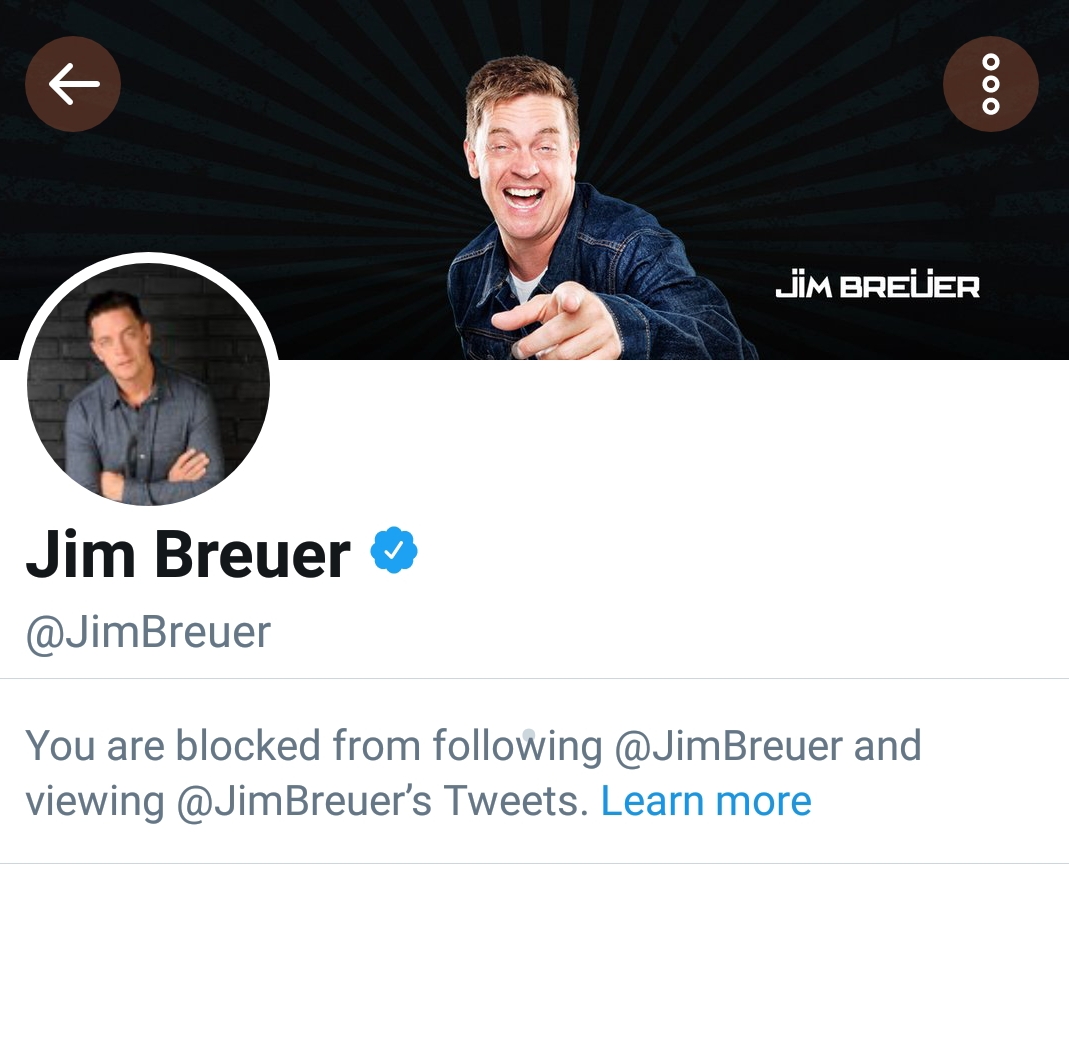
But alas, I've been blocked by Jim Breuer.

It all started a few weeks ago when I read an article on UltimateClassicRock.com entitled "Are Opening Acts a Thing of the Past?". The article details how Metallica is no longer touring with an opening act, instead opting to have Breuer, a longtime fan, act as MC to get the crowd warmed up.

The logic of the move to eliminate the opening act is that according to promoters, few fans are there to see the openers, so it is best to skip the formalities and jump right into Metallica. Which I can attest is a stupid idea. In 1999, I saw Sevendust, Creed, and Kid Rock open for Metallica in front of 75,000 fans at the Orange Bowl in Miami, and although each band was relatively new, they all kicked ass prior to the headliner.

But oddly, Breuer agrees with Metallica's new touring philosophy. He states the following:


From a comedian, I found this to be out of touch. Opening acts are part of the show, both in comedy and rock. I have seen Jim Breuer do stand-up a few times. Every time, there was an opening act.

So I tweeted my disagreement with Breuer's stance.


Breuer must have seen the tweet and not liked my opinion of his opinion as he replied:


Pretty sure Breuer didn't read the article before replying and telling me to take a nap. Which is unfortunate, because then we might have had an intelligent discourse on opening acts and modern tours. Maybe I am reading his comments the wrong way. But alas, Breuer was quick with block button, forbidding me from ever seeing his tweets again.


But I think there is another force at play here. I don't think Breuer was quick with the block because he was being a jerk, although that is a possibility. I think his emotions were running high on another target and I was collateral damage.

Jim Breuer is a huge Mets fan and the Mets were not having a good night.


Sometimes the Mets bring out the worst in people.

The next time Breuer comes to Tampa, I will buy a ticket. I am still a fan and I hold no ill will. I think think he is a funny dude. But I will print out the tweet calling me the "great critic of jerk patrol" and ask if he will autograph it. Maybe I will even make and wear a t-shirt that says "great critic of jerk patrol" and ask for a picture with Breuer.

You can't take life or twitter seriously.

Friday, December 22, 2017

How Pro Wrestlers Can Use Social Media


I wrote this article for a pro wrestling website in 2010. The article is no longer online so I wanted to repost it here. Some of the advice is a little outdated, but a majority of it still applies. Also, since 2010, professional wrestlers have fully embraced social media in ways that far exceed this article. Perhaps the biggest difference between what I wrote and what has happened is the continued blending of character and reality. There exists a weird pseudo-kayfabe these days, a model led by the WWE, where most wrestlers compete in character only in the ring. Outside the ring, there are normal athletes. The rare exceptions are the unnatural "monsters" of the ring, such as Braun Strowman. Even characters such as Bray Wyatt tweet football scores.

Other than that, here is my 2,600 advice column on how pro wrestlers can use the web to create a better brand.

Social Media and Self-Promotion: How Independent Pro Wrestlers Can Use the Web to Create a Better Brand

The world of marketing has become more and more individualistic in recent years. Businesses, both small and large alike, have taken to directly interacting with their customers through forums such as blogs, online video, and any one of many social networking sites (Facebook, MySpace, YouTube, etc.) . Gone are the days when customers were regarded as mass receivers of data and the recipients of “culture”, force-fed their likes and dislikes by money-making industries. In today’s market, the customer is now a target to interact with, listen to, and react to.

Few businesses have traditionally integrated the feedback of customers into their decisions better than professional wrestling.  The approval or disapproval of fans can make or break a wrestler’s career, or at least his or her character.  It is the fans who “put over” wrestlers, allowing for more exposure, more complex storylines, and more potential for marketing dollars.

In the book Steel Chair to the Head, writer and theater and film professor Sharon Mazer writes that the connection of fans to wrestlers is the lifeblood of the business.

“Everything about the event, from the advance publicity … to the action in the ring, has explicitly catered to (the fans).  The promoter promises he’s going to give them what they want: ‘real’ wrestling.  If it happens that what the promoter presents fails to fulfill their expectations, the fans have a way of telling him and his wrestlers so.” (Mazer, 72)

Unfortunately, a majority of marketing in the independent pro wrestling business is done by local promoters who, because of either lack of marketing ability or lack of budget, tend to only see the big picture for their company. These promoters will not usually go out of their way to “put over” individual workers.  Wrestlers, especially at the independent (non-WWE) level, are left to market and promote themselves.

Possibly due to the lack of assistance, many wrestlers choose only to promote themselves during the small window of time allotted to them during performances. They may sign a few autographs, pose in a few pictures, or even talk to a few fans. With an array of online platforms at their disposal, however, marketing and promoting only during the time granted by a promoter should not be the case.  Today’s wrestlers can take advantage of all the tools at their disposal and foster a digital connection with fans. They can easily break their reliance on promoters and push themselves as a brand, creating a buzz that will hopefully put “butts in the seats”.

This three-part guide is written help professional wrestlers promote themselves as a brand and take more control of their own promotion.

Step 1: Define Yourself: Go 100% Kayfabe or go 100% Real – There is No In-Between

The first decision a wrestler must make is how they want to approach their audience. Do they want to promote themselves as a “real” person or stay in “kayfabe” (aka their in-ring character)?  Do they want to be “Dwayne Johnson” or do they want to be “The Rock”? Under no circumstances should wrestlers should switch back and forth while engaging fans. Switching not only ruins the character, it distorts the fan’s expectation of what the brand actually is.  For an indy wrestler, imitating the pseudo-real characters presently popular in the WWE should be avoided at all cost.

The most effective way to stay in character is to create two online personalities – one for wrestling, and the other for personal interaction.  The latter web presence would be for interacting with friends, family, co-workers, etc and the former for engaging fans.  No matter how tempting, if wrestlers choose to market themselves and build their character online, they must stay in character, no matter what.  Fans will respect performers more in principle if they keep the curtain up than if they jerked the curtain up and down.

Additionally, keeping in character online means wrestlers should not in any way, shape, or form, add, befriend, follow, or otherwise network with anyone they have a feud with.  Ever. Wrestlers should make sure they correspond their online connections with their storylines so fans have no doubt as to where the wrestler stands on other performers.

Step 2: Create a “Home” Page

There are several online tools for engaging fans.  The first, and most important, is the home page.  The home page should be the first destination a fan can go to see the latest and greatest news about a wrestler – where they have wrestled, who they have wrestled, and, most importantly, where they are wrestling next. It should be the number one location fans find when they do an online search for a wrestler’s name.  The home page is also where wrestlers should post pictures, videos, and contact information.

These days it is entirely possible to have a homepage hosted on a third party site.  Wrestlers no longer need to purchase their URL (ex. www.WrestlersName.com) and or possess the web skills to create and post a web page, although owning the URL of their name is highly recommended.  Using platforms on the market today, wrestlers, even those with the smallest bit of programming talent, can create a decent central location for fans.

The most popular third party homepage is Facebook, with MySpace close behind.  Both of these social networking platforms allow wrestlers to post status updates, news, pictures, and videos.  Most importantly, however, they allow them to see their fan base and engage their fans either through comments or messages.

No matter what platform, the homepage should be kept up to date.  Like hitting the gym or practicing a promo, wrestlers should work on their online skills at least 3-5 days a week. Although sometimes the simplest announcement is enough to keep the fans’ interest level high, wrestlers should definitely spend time building and pushing information and interacting with as many fans as possible.

Step 3: Utilize Social Media

Along with home pages, wrestlers should also be proficient in other forms of social media.  Forums such as Twitter, Bulletin Boards, and YouTube should serve to supplement the wrestler’s online persona.  These sites should be avenues of not only communication, but broadcast.  Each of these tools can connect with audiences different from those on a home page.  Using these platforms is not about the in-ring performance at all. It is about letting character and personality come through.

Twitter – The microblogger service Twitter is immensely beneficial for wrestlers looking to promote themselves. It allows them to engage with an enormous amount of people, places, and things. Anyone on Twitter is a potential fan and target.  Wrestlers should attempt to broaden their fan base by interacting with as many people as possible. For a wrestler, the entire twitterverse is an audience. Wrestlers are not limited at all in who they can address via Twitter. They can harass or hail Oprah, belittle or befriend Aston Kutcher, or even imitate or insult Shaquille O’Neal. Twitter also allows for massive networking as workers can find and tweet with other wrestlers throughout the Twitterverse, as well as create relationships with local business, artists, media outlets, and other creative personalities.

The benefit of Twitter is not only in its ability to network and engage.  It can also be used as a blog.  Wrestlers can post updates, announcements, or links via Twitter. They can also create lists, allowing fans a glimpse into what people, places, and things the wrestler follows.

For those without much experience on Twitter, it would help to first follow a few people in various fields (again looking at celebrities, musicians, artists, businesses, etc.) and get a feel for the capability. After learning the system and seeing some of the tricks of the trade, the best thing to do is jump in with both feet. The truth of Twitter is that the more you engage, the better the benefit. On Twitter, the floor is open for those not only with the gift of gab, but also with any bit of creative networking ability.

Bulletin Boards – Perhaps the most common form of current interaction online between wrestlers and fans occurs in bulletin boards.  These sites, often run by fans, are places where the followers of wrestling discuss everything from storylines and performances to the subtle nuances that make for a great show. Although some bulletin board participants are experts in wrestling, a majority have never ever been active in the ring.  No matter their experience, they are nothing if not passionate. They love wrestling and enjoy engaging with similarly passionate fans.

Although participating in a bulletin board discussions is not a bad thing, wrestlers looking to increase their fan base and find new followers would be best advised to push their message elsewhere.  The fans on bulletin boards are already sold on wrestling and are likely to attend local shows regardless of the card. They are fans of the art and the overall production as much as of individual performers. Wrestlers should partake in board discussions sparingly, although they should still keep an eye out to gauge the diehard wrestling fans’ perception of their performance.

YouTube – One of the best and easiest ways for a wrestler to promote his or herself is via YouTube. It should be a natural fit for wrestlers to use the camera to promote their personalities and overall brand. Uploading videos to YouTube has a low barrier of entry and the potential for amazingly high reward.

A recent article by blogger Dan Schwabel on the social media web site Mashable.com[1] explores a three step process for users to establish themselves on YouTube.  Schwabel lists the following steps:
  • Brand Your Profile

  • Create Remarkable Videos

  • Promote Your Videos
Like homepages, these steps are not only applicable to businesses, but also to professional wrestlers.  “Brand your profile” means taking the time to create a specific YouTube location, or channel, where fans can go to watch all a wrestler’s matches, promos, or other adventures.  This is essential. Wrestlers should not depend on third parties to post matches and promos. If a promotion prohibits creating videos at their event due to trade secrets, their own pre-arranged contracts, or merely the need to exhibit control, then wrestlers should flood the web with outside-location character-building videos and promos.

What wrestlers put on these videos is Schwabel’s second step. Wrestlers should look beyond the mat to sell themselves as entertainers. As wrestling is at least half performance, YouTube provides the ideal medium for out-of-the-ring creativity.  Wrestlers could not only cut their own promos, they could create short skits of the wrestler interacting on the street, in the mall, at the mayor’s office, etc. Of course, the more the skit fits the wrestler’s personality, the better. These skits could even be similar to those used by the WWE, then WWF, in the late 1980s and early 1990s. For example, if a wrestler played a solider gimmick, he or she might want to create a skit at the local VFW or National Guard armory. The possibilities are endless.

Schwabel’s final step is to “Promote Your videos”. This means bringing the social media net together. This step involves embedding videos on a home page, posting it on a bulletin board, and putting the link on Twitter. This is the selling step and requires almost as much work as the creating step. However, the more media a wrestler has across the Internet, the better the chances a fan is going to see the wrestler. Of course, like any other video maker, wrestlers should aspire to get their videos to “go viral”, and have fans push and promote the videos to their friends, followers, and other influential entities. Then those people push it to their friends, who post it and push it to their friends and so on. Once a wrestler’s video goes viral, it is just a matter of time before the fans buy a ticket and see them at a wrestling show.

Step 4: Connect the Web with the Ring

Social media and networking doesn’t stop when a wrestler gets off a computer. Brand marketing should continue at the show and in the ring. Wrestlers should make the most of the time given to them by promoters and push their web sites, Twitter feeds, Facebook pages, MySpace pages, and any other platform to the fans. Wrestlers should do whatever it takes to integrate their online personas with their in-ring personas. Some ideas may include promoting their web page in promos, their Facebook address on t-shirts, their twitter account on photos, their YouTube channel on business cards, their MySpace page on flyers, or even putting their email address on autographs. Any mixing and matching of online reminders and real life souvenirs provides fans the ability to look for more.

Optimally, the best situation is where a fan goes to a show for the first time and is so interested in the character and ability of a wrestler that he or she looks up the wrestler’s online presence. If the wrestler is on any one of the many sites mentioned above, the first-time fan could easily grow to become a full-time fan. And when the wrestler notices the fan joining his or her following, the wrestler pushes content to the fan. The fan then absorbs the content and grows more and more interested in returning.  When the second match does occur, the first-time fan becomes a second-time fan. Then the second-time fan sees, reads, or hears a reminder from the wrestler to visit the wrestler’s page again. Hopefully the process becomes ongoing and the wrestler has his or herself a legitimate fan base. A fan base that puts butts in the seats no matter where the wrestler is booked or who is doing the booking.

Step 5: Stay Flexible but Remember Your Brand

Many wrestlers choose not to push themselves via social media because they are unsure of the direction of their character. Under the current system, promoters drive wrestlers’ characters, forcing them to play the role of heel one week and possibly face the next. Unless they have a strong gimmick, wrestlers can’t tell a promoter they will not play a certain role for fear of lack of work. Accordingly, if wrestlers don’t know their role, how can they maintain a constant message to the fans? Wouldn’t social media have an opposite effect if the fans are expecting one character only to see a complete opposite emerge from behind the curtain?

The answer to this dilemma is that wrestlers must stay flexible but absolutely, without a doubt remember their brand. That brand is their selling point. Wrestlers should turn down any promoter who tries to put them in a story line that would ruin days, weeks, months, or even years of self-establishment. Wrestlers need to maintain their gimmick and insist promoters respect their work, for if the wrestler has a strong enough buzz he or she will have a profound effect on the attendance. And of course, attendance leads to dollars which leads to a happy promoter.

Even if a promoter or storyline causes a jarring shift in a wrestler’s character, a good social media campaign should be able to compensate. With an active online presence that conveys the character’s feelings on a regular basis, wrestlers may be able to use creative license and add additional details or background to the storyline. A growing and continuous story will lead to a self-fulfilling cycle of fans who demand more information.

Step 6: Have Fun

Lastly, the most important point about using social media to promote and interact is that it should be fun. Social websites should be an enjoyable way to interact with the fans, watch communities grow, and eventually see more people come out and support local independent wrestling. There is no rule that says wrestlers must have an online presence, and many wrestlers have been successful without being on the Web. But for those wrestlers who want to take their characters and gimmicks to the next level and expand their creative potential, the entire social Web can be their squared circle.

[1] http://mashable.com/2009/11/04/youtube-personal-brand/

Friday, June 16, 2017

I made a good tweet

I've been on twitter for about eight years. I have a little over 1,000 followers. I'm not a big time social media star. I tweet about the wide array of things that appeal to me or catch my eye.

A few people respond to me regularly, and I reply back to them.

Only three times in eight years have my tweets been circulated to the masses.

The first was a picture of me in an R2D2 costume from 1982. I tweeted that to @StarWars and they retweeted it to the rest of the galaxy.

The second time my tweet was heavily circulated was when I posted a Chuck D song about Muhammad Ali after Muhammad Ali died. Chuck D retweeted that to all the Public Enemy fans worldwide.

So it usually takes someone popular to push my tweets to the masses.

Last week, however, after New Jersey Governor Chris Christie called President Trump's tone to the ex-FBI director "normal New York City conversation", I posted this:


As you can see, a lot of people interacted with this post. I was shocked. Granted, it's not millions or thousands and I am not asking for free nuggets, but nearly 200 retweets and over 600 likes for a joke isn't bad.

My theory is that the tweet jumped in popularity when Twitter posted it on their top tweets for the topic. If you went to the twitter home page, there was a headline of "New York City conversation". Clicking the headline brought you to dozens and dozens of tweets about the subject. As mine was pretty popular, it rose to the top, which then made it more popular. Twitter is weird like that.

So that's my most popular tweet to date. Mr. Met engaging in a normal New York City conversation.

Monday, November 21, 2016

The insanity of political memes

Like bumper stickers to generations, political memes have become the preferred way of choice for people to communicate their political views. They allow people to make big points with little effort. Simply take an image, put some text on the top and bottom, and you have a meme. You get bonus points if it is funny or as some sort of twist to the punchline.

For example, I created this one from a site called memegenerator.com.

68858358

Not overly funny, but the character's face combined with the condescending question does send a message.

While the above meme attacks meme culture, most political memes are for the in-group and condescending towards the "others".

But what if two memes on the same subject with different perspectives were put together?

14642080_10207247317649772_7183859696795890573_n

The premise is the same: comparing the words of Donald Trump to the use of different gendered bathrooms by transexual individuals. But each meme takes a completely different perspective and attempts to insult the intelligence of the "others".

The meme on the left assumes transsexuals are not a threat, but Donald Trump is. The meme on the right assumes Donald Trump is not a threat, but transsexuals are.

It is easy to spread propaganda on Facebook. It has become a sandbox for tribalism and group identity. But when we pull media out of Facebook and look at it critically, we see how unoriginal it really is. But like a homemade bomb, it is simple, but effective.

Friday, February 19, 2016

Quick thought on internet bullies and wimps

52385104Before the end of 2015, there was a post on qz.com entitled "We’re the reason we can’t have nice things on the internet". The article was about internet bullying and antagonistic behavior online. The phenomenon has grown beyond "trolling", and seems to be a permanent part of culture.

As the internet has grown from a place academics exchanged ideas, to a place where computer nerds toiled (when I came in), to a place where everyone has the same platform for expression, it's become a very harsh landscape. And while the bullies that get the most attention are the ones that use the most coarse language, there is one category of terms that I think requires discussion.

  • "Don't be a pussy/wimp/bitch/girl, etc."

  • "Grow a pair."

  • "Tough it out."

  • "Get out of your safe zone."

  • Etc


This is a common refrain. Putting aside the sexist undertones of "bitch/pussy/girl/etc", let's dissect these phrases from a systematic approach.

These phrases assume "the complainer" should comply with the system as is. The complainer shouldn't complain about the system because the system is correct in how it works. It is the complainer's fault he or she is having a tough time in the system. The system is the best way it is and the best way it can be.

These phrases also implies the bully is dishing out "tough love" to the complainer so the complainer can survive in the system. Of course, the bully is at home in the system, or else the bully would be complaining as well. So the system is fine for the bully. The bully doesn't want the system upset because the bully exists in that system and the bully has power in that system. Rearrange the system and the bully might not have power anymore.

So it is in the bully's best interest that the "complainer" learn how to survive in the system in which the bully has power. The complainer may survive and be fine in the bully's system, or they may not. The complainer may even get power in the bully's system. Good for them, but it doesn't diminish the bully's power.

But the bully will always have power in the bully's system. And the bully wants to keep that power. The bully wants to conserve power, not cede it. The bully wants to conserve the status quo, not progress to another system in which the rules of power are different. Losing power would mean the bully can no longer be a master of the system. The bully can no longer determine the rules of the system or give people advice on how to survive in the system.

That's not good for the bully. A new system would mean the bully needs to understand new rules and new norms. The bully might not be tough there. The bully might cry. The bully would become a wimp. People might pick on the former bully as the bully struggles in the new power structure. Someone might tell the bully to grow a pair, stop being a wimp, or to tough it out.

And the bully can't have that.

Monday, June 8, 2015

A Constructive Facebook Discussion on Raising Minimum Wage

A little while back, a few Facebook friends were debating the merits of raising the national minimum wage. One posted a link to an article entitled "Fast Food Workers: You Don’t Deserve $15 an Hour to Flip Burgers, and That’s OK" and commented about its viability.

The article is a letter to those in the fast-food industry and claims the jobs they hold are not "worth" the pay these workers are requesting via protests and social media efforts.
I want to talk to those of you who actually consider yourselves entitled to close to a $29,000 a year full-time salary for doing a job that requires no skill, no expertise and no education; those who think a fry cook ought to earn an entry-level income similar to a dental assistant; those who insist the guy putting the lettuce on my Big Mac ought to make more than the emergency medical technician who saves lives for a living; those who believe you should automatically be able to “live comfortably,” as if “comfort” is a human right.

...
So, real talk: Your job isn’t worth 15 bucks an hour. Sure, as a human being, you’re priceless. As a child of God, you’re precious, a work of art, a freaking miracle. But your job wrapping hamburgers in foil and putting them in paper bags — that has a price tag, and the price tag ain’t anywhere close to the one our economy and society puts on teachers and mechanics.

Don’t like it? Well, you shouldn’t. It’s fast food. It’s menial. It’s mindless. It’s not supposed to be a career. It’s not supposed to be a living. An entry-level position making roast beef sandwiches at Arby’s isn’t meant to be something you do for 26 years.

It isn’t paying enough? OK, get another job. Get a second job. Get a third job. Get a different job.

When my friend posted this on Facebook, I immediately saw the flaw in the article. The article, like most people in the minimum wage debate, isn't attacking the right target. Those for a minimum wage increase are looking towards politicians for support and those against a minimum wage increase are attacking the laborers saying they don't "deserve" it.

No one is attacking the companies and their profit margins. The truth, like most issues, lay in the middle.

Here is what I posted on my friend's Facebook wall:

None of the arguments are approaching this right. They should be looking at the total amount of profit generated by the corporations, looking at the dividends paid to shareholders, the cash holdings of corporations, dividing that by the amount of lowest level employees, and negotiating that companies reduce their profits by a rational amount. Sure minimum wage is low, and we can argue semantics of the word "minimum" and what it means to work hard, but those are all semantics. If you want your boss to share the profits, you have to calculate your labor to your generated profits.

Friend's reply: Lots of companies pay a living wage without it affecting prices. Costco is a great example. Low turnover, excellent service, excellent job satisfaction, and hugely profitable.

My response: Costco is a good example - increasing shareholders and employee income - but are they the norm when it comes to profits? Or are they an outlier?

Friend's reply: They are an outlier, but why? Their model is a successful one. They are only an outlier because so few are willing to follow the (successful) model, which makes no sense.

My response: Because we don't teach our corporate leaders morality. Why are bank tellers making only $13 an hour while bank CEOs and Wall St fat cats making millions in bonuses? It's not fair, and perhaps like the labor advancements of the early 20th century (child labor laws, unions, etc), we are entering a new era of corporate idealism. But you can't mandate business models from government. It has to be done by labor force movements or by management.

Friend's reply: It is the value of money / value of people debate. I will always stand on the side of treating humans with dignity and Respect.

My final response:
And we do need that. And we need business schools etc to teach business students to care about more than money. We need them to take social sciences classes so they understand the cultures in which their businesses operate. We need to discourage investment in companies that don't treat their people right. (This is turning into my own blog post. Sorry!)

------

I don't normally get into long conversations on Facebook. They usually get out of control very quickly. Or people get offended. But this was a good conversation.

Thursday, December 18, 2014

Coastal Hyundai, Bad Customer Service, doing social media wrong


I am the proud owner of a 2013 Hyundai Elantra. I bought it new, and love it. It's great on gas, comfortable, and everything I need for where I am in life.

But while Hyundai has a great warranty, the one thing I don't like is how they constantly send me emails about their newest models and deals. I have tried to unsubscribe, but that never seems to work. They are automated and will probably never go away.

However, I do expect to be removed from a specific Hyundai dealership's mailing list. Especially if I ask them to remove me. Especially if that request is reiterated every month.

Somehow, Coastal Hyundai of Melbourne, Florida received my contact information and will not leave me alone. I have never dealt with Coastal Hyundai and I doubt I have will. I bought my vehicle at an Ocala, Florida, Hyundai location. The Ocala dealership called me once and I told the gentleman on the line I was not interested. He was very nice, understood, and then asked how I liked the car I did buy. I would do business with them again.

Unfortunately, despite my pleas, Coastal Hyundai will not stop. This despite the fact that I did not buy my vehicle there.

Yet they badger me. I have spoken with their general managers. I have spoken with other managers. I have talked to whoever answers their phone. All claim to remove me from their mailing and email lists. I still get emails and unwanted literature.

This has gone on for over 6 months.

So with personal contact not working, I decided to look up Coastal Hyundai on social media. Perhaps a well-placed complaint could get done what monthly calls could not.

For a well-established car dealership, Coastal Hyundai's social media presence is pathetic. It is obvious they created twitter and Facebook accounts because they either had to or felt it would be "the cool thing to do". They don't interact with customers on either. Even worse, their twitter account is only forwarded Facebook posts.

That's not how you "do" twitter.

Can I expect a response if I reach out on twitter? Why have an account customers can use if you don't interact on it? That's bad social media 101. Customers will have to find an avenue in which to get a response. How long should customers wait to get a response? Just terrible.

If you are not going interact on a social media platform, don't create an account. Keep announcements and pushed media on your website.

With a twitter response unlikely, I went to Coastal Hyundai's Facebook page. This isn't much better than their twitter account. They do have 661 followers and a post every few days, but interactions are nearly nil. Their most recent posts are only "liked" by the dealership general manager and earlier posts are only "liked" by another employees. That's not good.

It is obvious Coastal Hyundai is not connecting to their customers via Facebook or twitter. And with their constant disregard of my requests to be removed from their mail and email list, it is obvious they don't listen to customers over the phone either. Worse, I was never a customer.

I don't know what else I have to do to in order to have Coastal Hyundai remove me from their marketing lists. I want nothing to do with them. Maybe I should contact Hyundai's corporate offices? Maybe I should file a complaint with the Melbourne Chamber of Commerce? Maybe the Better Business Bureau?

Maybe this post will work.

Dear Coastal Hyundai, leave me alone.

Friday, September 5, 2014

National Lampoon, Leaked Photos, and Voyeur Culture


In 1985, Clark Griswold and his family traveled to Europe. While in London, Clark mischievously recorded his wife getting out of the shower. Ellen then did a seductive dance for her husband and the two commenced in intimate moments while the camera recorded. A few days later, while the family was in Paris, their camera was stolen.


Several days after the theft, Ellen saw a picture of herself during the recorded moments in an advertisement on the side of a bus. The advertisement was for an adult movie. As to be expected, she was embarrassed and angry at her husband for not erasing the material.

In the wake of the latest theft of celebrity intimate photos, is the above scenario still funny?

Also, who do you think is to blame - if anyone - in the above scenario?
  • Ellen Griswold

  • Clark Griswold

  • The Paris thief

  • The distributor

  • The bus company for promoting

  • The market for such a video
Personally, I hate "blame". People get too busy blaming and pointing fingers, and not fixing problems. What's done is done. After the incident occurs, the next step is to make sure it doesn't happen again. In the Griswold case, that might mean Clark is never able to operate the camera again. Or they don't make intimate videos again. Or they never hand their camera to strangers again. Or they ensure the thief is prosecuted to the utmost extent of the law, intimidating potential thieves. Or they could start a campaign trying to change the voyeur culture. Either way, effective countermeasures may be taken.

Or not.

Monday, August 25, 2014

Social Media and the Military - The Russian Problem

In December 1992, US Marines and Navy Seals landed on a beach in Somalia to begin their mission in the war-torn country. According to the New York Times,
The Marines mounted a textbook operation, which began with well-armed Seals and reconnaissance teams coming ashore to check the beach for mines and hostile defenders, followed by an assault force.

But there was one little problem. When the Marines hit the shore, they encountered a force they didn't expect. Not armed with guns, tanks, or artillery, this force was equipped with cameras, notepads, and spotlights.

Aware of the mission, the media had beat the Marines to location.
As Navy Seals and Marine reconnaissance teams came shore under the glare of television lights, the spotlights and flash attachments gave away their positions, interfered with their sophisticated night-vision equipment and gave night blindness to commandos who wanted to have their eyes fully adjusted to darkness in case they were attacked from the dunes and scrub.

Oops.

According the article, there was miscommunication between the Pentagon and the media. The Pentagon let the media know when and where the forces would be, but the notice of what effect the media presence would have on the landing forces was not mentioned.
the Pentagon issued a press advisory asking correspondents to stay off the beaches and began the time-consuming process of faxing them to news organizations in the United States. In some cases the advisory was not faxed to news organizations until 6 P.M., after the Seals landed. It was unclear whether any effort was made to contact foreign news organizations.

That's not good.

In the 22 years since, the relationship between "media" and military operations is still contentious. "Media" is no longer only the major networks or newspapers. It's everyone with a smart phone and access to social media websites such as Twitter, Facebook, Instagram, etc. That we have the ability to broadcast everything (and are encouraged to!) has not only caught many information security services off-guard, but has them scrambling to put band-aids on gaping wounds.

Once information is public, it is incredibly hard, if not impossible, to put the genie back in the bottle.

The reason I highlight this 22 year issue because I recently found out this isn't just a US problem, it's an everywhere problem. A recent post by GlobalVoices.com discussed how Russian troops were taking pictures of themselves on military operations in Ukraine and posting them on Facebook, Twitter, and other social media websites.
The Russian website TJournal.ru has produced an excellent roundup of the mounting photographic evidence of Russia's military presence at the border with Ukraine—all culled from Vkontakte accounts belonging to Grigoryev and his comrades. TJournal reporters found other posts mentioning Ukraine, and discovered that one of Grigoryev's VK friends even published a map of their route, which began in the town of Ordzhonikidzevskaya in Ingushetia (a region of the Russian North Caucasus) and ended in the village of Pokrovske, in the Rostov region, on the border with Ukraine.

Oops.

Of course, the soldier in question says he was "hacked" and the Russian military is responding as only they know how.
On July 29, the Russian media reported that Vadim Solovyov, a Communist Party Duma deputy, is working on amendments to the Federal law on military service that would essentially ban army servicemen from posting to social networks any photos depicting military equipment or arms. Highly sensitive information conveyed in such images, the deputy believes, undermines state security and “could be used by the Western media for provocations.” Solovyov does say that soldiers will still be allowed to use the Internet for personal correspondence.

Good luck with that.

As Princess Leia said in Star Wars, "The more you tighten your grip, the more star systems will slip through your fingers."

Monday, May 19, 2014

The annoying trend of phones at concerts

FIX

Regular readers of this site know I am an avid concert-goer. I am at a live music performance at least every other week (gotta leave some time for stand-up comedy and pro wrestling).

By far one of the worst recent trends at concerts is the increasing inclination of concert goers to stick their phones in the air and attempt to record performances.

There is one and only one reason people do this: so they can upload them to YouTube and hope the rest of the fanbase sees their work. I guess they feel they have to put the videos out there for the advancement of the fanbase and maybe the advancement of their ego.

Don't get me wrong, I have no problem with taking a picture of a concert. Although there are professionals that do that better, a self-taken picture at a unique angle makes a nice memento. But taking a picture doesn't last long and the phone or camera is usually back below eye level in a moment or two.

Completely recording performances, on the other hand, has to stop. It is incredibly annoying and serves no purpose.

None.

Take a look at the following videos. Same song, same concert. The first was taken by RockScene.com. The second by some person in the audience.


Pretty professional, no? Sounded good, good view of the whole stage, and not obstructed at all.

Now watch video 2.


Not very good at all. Limited view of the stage. Can't get a view of the performance. Sound is worse. And everyone around also has their phone in the air trying to take video. The other phones are cannibalizing the video.

What is the point of everyone trying to take a video of a concert? Do we really need 500 different YouTube videos of the same song? Do these people really not trust that the performance will be recorded and uploaded by someone who can get a good shot or good location?

Perhaps the people who want a recording can volunteer one person to record the show. That person would bring an HD camera to the show, set up, and record. Then, after the show, they would upload the video to YouTube. If people want to make sure they see it, they can put their email address or phone number on a list and the uploader will ensure the person requesting gets a link.

Sounds ridiculous, right? But so is the plague of recording concerts with phones. Unfortunately, knowing our society's need to video or take photos of everything, I don't think it will ever go away.

Unless Glenn Danzig does something about it.


Wednesday, January 22, 2014

Protesting Presidents and Attributing Tweets

On Monday, Jan 20th, a candidate for Florida's 68th Congressional Seat got himself in a bit of hot water. According to many media reports, candidate Joshua Black, a taxi driver from Pinellas County, Florida, called for President Obama to be impeached and hung.
"I'm past impeachment," Joshua Black wrote on Twitter. "It's time to arrest and hang him high." - Tampa Bay Times

A Republican candidate for the Florida House is calling for the arrest and execution by hanging of President Barack Obama for treason — but only after a trial. - TheNewCivilRightsMovement.com

Joshua Black, candidate for House District 68, made the comment in a Tweet Monday saying he was “past impeachment” and that “It’s time to arrest and hang him high.” - CBS Miami

Joshua Black, who’s running as a Republican for the 68th legislative district, Tweeted on Martin Luther King Day that Obama should be arrested and then “hang him high.” - ColorLines.com

Monday, he tweeted: - ThinkProgress.org

A Republican candidate for the Florida House of Representatives District 68 seat, Black tweeted, "I'm past impeachment. It's time to arrest and hang him high." The comment gained national attention after being brought to light in a Tampa Bay Times political blog. - BayNews9 (Tampa)

The problem with all these media articles is that Black DID NOT actually tweet that.

Here is the tweet in question:

Notice the quotation marks before @civilwarcometh and after commieblaster.com. That means the tweet was a quote. All Black added was "Agreed."

Here is the original tweet from @civilwarcometh:

Black quoted this tweet in his own. Some publications did observe the difference and cite properly.
The remark that launched a thousand tweets came when Florida state representative candidate Joshua Black simply agreed with a comment from another user. - TheDailySheeple.com

When one of Black's followers tweeted, "I'm past impeachment. It's time to arrest and hang him high," Black simply wrote back: "agreed."- Complex.com

He tweeted in agreement with a fellow Twitter user (Stephen Abner) who called for the U.S. president to be executed. - Canoe.ca

Black's official campaign Twitter got behind a plan by one of his followers yesterday: - Gawker.com

Black didn't do himself any favors by re-writing the above tweet in his own Facebook post, confirming he believes in the idea. But again, my point is not to defend him. My point to show that many media members are still unsure how to properly cite Twitter.

This ambiguity is why many people and organizations attempt to put distance between Tweets they type and their quotes and re-tweets. Hence the common "RTs do not = endorsement" phrase in Twitter profiles.

Let me make this clear one more time: I do not agree with Joshua Black. Not one iota. However, I do think many media outlets attributed something to him that he didn't write, although it seems he has no problem claiming credit for it.

Stay tuned next week when I quote the Gettysburg Address on twitter. Feel free to say I wrote it!

Wednesday, April 18, 2012

What the Pro Wrestling Hall of Fame Needs To Do To Be Relevant

With another WrestleMania Weekend recently behind us, I thought I would take a moment and look at the idea of a place to acknowledge the best of the squared circle. A place where fans can learn about the past and celebrate those who have made pro wrestling into the institution it is today.

Until recently, I had no idea there was a Professional Wrestling Hall of Fame and Museum. Located in Amsterdam, New York and established in 2002, the PWHF, according to its mission statement, strives to “maintain organized volunteerism that preserves and promotes the dignified history of professional wrestling.”

Since 2002, the Pro Wrestling Hall of Fame and Museum has had backing by a who’s who of prominent names in pro wrestling history. And every year since 2002, they have inducted some of the biggest legends in the business. Despite their hard work and love of professional wrestling, however, unless something drastically changes, the Pro Wrestling Hall of Fame and Museum will never become the wrestling fan mecca it should be. Unfortunately, as things are now, there are five big reasons why the PWHF is doomed for an eventual failure.

Location – After a few years in Schenectady, the PWHF moved to Amsterdam, New York in 2005. Amsterdam, New York is a small town of 18,620 located 180 miles north of New York City according to Google Maps. Even if there was historically rational reason to housing the PWHF in Amsterdam, a la the Baseball Hall of Fame in similarly small Cooperstown, that is a terrible location. In order to raise public awareness, the PWHF should move to a city, preferably one with a rich wrestling history such New York, Atlanta, St. Louis (a city with its own wrestling hall of fame), Memphis, or perhaps even my city of Tampa.

Web Presence and Social Media– If the PWHF is insistent in staying in small-town upstate New York, it needs to revamp its social media and web presence. While the PWHF website isn’t terrible, there are a few things I would like to suggest.

First, I would like to see videos if possible in the bio section. Maybe even a PWHF Hall of Fame video highlight reel with a nice voice over. Second, the gallery hasn’t been updated since 2009. That’s not good at all. Third, if it is a museum, are there any exhibits? Any old belts, turnbuckles, programs, etc.? Pictures of these types of pieces with stories of the items would be a nice touch. Although pro wrestling is mostly about the people, it is also about the events, the rings, and the titles. Those are the glue that hold the history of the sport together.

Whereas the website isn’t that bad, the rest of the PWHF’s web presence needs a lot of work, especially if it wants to capture the interest of casual wrestling fans. Of course, this means the social media mainstays of Facebook, Twitter, and YouTube.

A Facebook search of “Pro Wrestling Hall of Fame” brings up a lot of different pages, none of which I can surely say represent the PWHF. There is an informational page which describes the museum, but there is no fan page that interacts with wrestling fans or promotes upcoming events at the museum. Once that is established, perhaps the PWHF’s page could post facts about inductees and exhibits, maybe even a fact, video, or trivia question of the day.

Only slightly better is the PWHF’s twitter presence. Although it appears they have an account, it doesn’t look like anyone has used it since November 2010, and that was after a nine month gap in tweeting. Like Facebook, twitter would be a great way for the PWHF to engage fans and raise awareness. When so many wrestling fans are active on twitter and Facebook, for the PWHF to not be active on either is sad.

Despite the fact that they have a youtube video embedded on their homepage, the PWHF’s youtube usage also needs a ton of work. Until recently, their front page featured a youtube video that wasn't even from the organization’s youtube page. It was from a youtube channel that also featured some “tea party” propaganda videos. I don’t think political party propaganda is the type of stuff the Pro Wrestling Hall of Fame and Museum should be associated with.

(Note: they recently changed it, but to another page that only partially has anything to do with the Hall of Fame. There are wrestling videos, but few are about the PWHF.)

As for their actual PWHF youtube page, it has three videos off the museum, one from 2010, one from 2009, and a generic video. The page also has a 30 second spot of TNA visiting Amsterdam. Why the last video is there, I have no idea. And why the 2011 Hall of Fame video is not on the official PWHF page is also a mystery. There is no reason why the page isn’t a robust forum of interviews, exhibits, and other propaganda about the museum.

Volunteerism – From checking out their homepage and other assorted information about them throughout the internet, I get the impression that the PWHF is proud of their volunteer, non-profit status. That would be fine if they were located in a big city, but in small-town New York, I am guessing the pool of volunteers they can pull from is quite low. Perhaps if they were a for-profit company they could attract more employees, employees who could help market and promote the museum. Volunteerism is great if you are where free labor is bountiful, such as a major college town, but I think for the PWHF it is now a liability.

Non-Affiliation – According to its website, the PWHF takes pride in not being affiliated with any one professional wrestling organization. It is not in cahoots with the WWE, NWA, or any other international, national, or regional organization. Whereas in the tricky world of pro wrestling, this might have been a good idea initially, I think it is actually to the PWHF’s detriment. Affiliating with the NWA, for example, may allow the PWHF to freely use video and other items – possibly even exhibits – from the organization’s rich history. Being in the official hall of fame of other organizations as well would also mean access to their archives and property.

The WWE Hall of Fame – We all know it’s coming. Eventually the WWE will build a physical home for its Hall of Fame. It will attract wrestling fans from far and wide. It will squash any and all regional or small-town halls of fame and museums that attempt to tell the story about the rest of professional wrestling. And it will be the default “pro wrestling Hall of Fame” for casual fans and non-fans alike. If the WWE Hall of Fame doesn’t strike a death knell for the current Pro Wrestling Hall of Fame, it will greatly hurt its chances of succeeding as a tourist destination. Everything the WWE does, it does big, and there is no doubt a WWE Hall of Fame would follow suit.

The PWHF can circumvent being the “other” pro wrestling hall of fame if, after gaining the blessing and affiliation of NWA, TNA, and other regional wrestling organization, it reaches out to the WWE. If the PWHF takes in all WWE Hall of Famers and acknowledges the WWE Hall of Fame as part and parcel of the PWHF, it might also be able to utilize the WWE’s huge marketing juggernaut. This is a story of David convincing Goliath to work with him, but if the PWHF gets it other ducks in a row, then it might have a chance to convince the WWE to outsource the care and maintenance of a physical hall of fame to the PWHF.

I’d like to see the PWHF succeed. I really would. It would be great to see a hall of fame and museum dedicated to pro wrestling that tells the entire story of the sport, and includes everyone from every organization from every country in the world, not just from the biggest pro wrestling company. In a perfect world, a metropolitan-located PWHF would receive footage, rights, and exhibits from Vince McMahon, the powers that be at the NWA, and other groups from around the world, making the Pro Wrestling Hall of Fame a mecca of pro wrestling history and celebration.

Tuesday, December 27, 2011

Thoughts on Commenting and Community


Here is something I wrote five years ago when I first started blogging. As more and more people spend more and more time online, I think it is increasingly relevant. Also, as the web becomes more mainstream, I have seen the idea of a "tolerant global community" diminish somewhat. Also, looking back I think the "globalness" of the web as been wiped out by "localized social groups". I think part of the "social customization" of the web is to blame for that, but that's a Pandora's Box of social commentary for another day.

I think the Internet and our reliance on non-personal communication has been a blessing and a curse. While everyone can communicate with all across the world, technology has created a "have" and "have not" climate in terms of face-to-face interaction. We are not becoming one global village. We are becoming two groups: one communal village of interactors and a second cynical group of individuals who express their opinions but choose not to participate.

This second entity can be quite dangerous. Whether informed or unlearned, the Internet as given everyone a voice. These mostly cynical views can splinter attempts at a tolerant global community if allowed. If enough people choose to follow a dissenting voice or group of voices, the attempt at harmony will be destroyed.

Cynical web sites, blogs, and comments are similar to the Grinch mailing down propaganda to Wooville on a daily basis bemoaning the Woo's emphasis on their Christmas holiday. We have gone too far to pull back and retreat into isolationism. Reasonable tolerance is the only answer. Negotiate where one's group ends and another's individual options begin. Throwing rocks at glass houses is not an option.

Tuesday, September 20, 2011

An Interview with Sam Ford on Social Media and Pro Wrestling

(This post was originally posted at The Wrestling Blog.)

Last year I was able to exchange emails with Sam Ford, Director of Digital Strategy at Peppercom and co-editor of The Survival of Soap Opera: Transformations for a New Media Era. Sam is also a huge wrestling fan who has written about storytelling in wrestling and even made an appearance on the Dave Lagana podcast. Sam was cool with me posting our social media-based interview here. Even though we talked in October 2010, many of these points are still very relevant, especially in the indy scene.

- How has new online media channels changed the process for independent wrestling promoters?

Sam Ford: I think social media has provided more opportunities to change the process for independent wrestling promoters than they have often picked up on. #1, the ability to tell stories between live shows now makes it possible to build feuds--and interest in shows--beyond just posters. Build up the matches beforehand. Increase the drama of the story between shows through featuring news and interviews on the site, etc. #2, the ability to connect various live shows together in a common narrative is now possible as well. As a regional promoter travels across cities in an area, online media channels actually gives him/her the opportunity to connect the events at each show to build an ongoing narrative. People may not be able to go to a live show three hours away, but what happens at that show can be woven into the storylines now. And, for more ardent fans, you might encourage them to more faithfully follow your promotion around from town to town.

- Is social media essential? Or can promoters get by with only traditional media?

Sam Ford: Social media isn't essential. Pro wrestling can still draw crowds through a promotional poster at the local grocery store. The issue is that traditional media makes it a new selling proposition each time. It's hard to gain and maintain regular ardent fans through the poster. A website and presence for the promotion acts in lieu of a local television show. Since most promoters can't afford or don't have the option of a weekly TV show for their region these days, the website offers that regular promotional vehicle to keep the promotion and its characters top-of-mind and to encourage people to plan for and anticipate the next time the promotion comes to town.

- How important is establishing/maintaining a community of fans for a promotion?

Sam Ford: It's always been important to maintain a community of fans for local wrestling to thrive. Local shows survive in part because it gives an excuse for wrestling fans to come together and see one another and participate communally in something they love: cheering their heroes, and booing their villains. Online tools just give us a chance to maintain community across multiple cities, to keep people connected between shows, etc.--especially important if the promotion's shows don't happen on a frequent basis at the same time and the same place each time.

- What is the biggest difference in how a promoter would use social media as compared to a wrestler?

Sam Ford: The promoter's focus is on his promotion and the storylines of his show. The promoter is going to be using social media to build a following for their character across all their appearances for multiple promotions. The key is for the promoter to come up with ideas that serves the wrestlers' goals of self-promotion while also building stories online. Getting talent to participate in online storylines, etc., can be accomplished by the promoter being sure to have permission to build stories themselves or to give tangible benefit to talent as to how helping build up a feud online will lead to greater ticket sales, a deeper following for their character, etc.

- What is the single most important tool a promoter can/should use to get the word out about his show?

Sam Ford: I think it has to do with networking with fan sites, etc., and doing something that goes beyond announcing a list of matches and results from a card. No matter what platform you use, how do you tell a story that compels people to come join you in person?

- What are some of the more creative endeavors you have seen in regards to promotions using social media?

Sam Ford: Because WWE has such a media machine behind them, we've seen them build storylines through their website and elsewhere in the past. But they haven't even taken great advantage. I have seen indy promotions have wrestlers/personalities bicker with each other in fan boards and elsewhere, start or further feuds with announcements on their site--special interviews--etc., that allow the storylines to go much deeper than a spot show can.

- What are your thoughts on continuing storylines through social media?

Sam Ford: I think it will be a real difference-maker for promoters once they get used to it, learn to do it well, and condition fans to look for it. The key is to build references to this online content into the show itself in order to drive fans back to the web to keep up with it.

Monday, July 25, 2011

The Curse of the Evil Online Ego


Quick post today based on something interesting I read on Wired.com:

In an article entitled "Pseudonymity, Anonymity, And Accountability Online", author Sheril Kirshenbaum discusses her opinion of another article on the Wild, Wild West of Internet commenting.

(Yes, this is a post about a post about a post.)

This discussion of how people choose to comment on the Web behind the cloak of anonymity has gone on for a while among people who observe culture, media, and technology. The Web is not for the sensitive, bringing out the worst in racism, sexism, and overall meanness.

But there is another less-talked about effect of the Web. That which may even have an effect on lives offline.

There is an allure to be egotistical online. What you write comes from you and is your opinion and your words and often times, being from you, they have to be right. And when faced with the slightest bit of objection, people online tend to either coat their expression in the Internet language of snark or they become highly combative. Neither of which is very healthy.

The Internet has unfortunately decreased our ability to have civil discussion and instead preached argument. It has fostered a culture in which a solo opinion is all that matters and that people have to outshout or outargue everyone else.

If you do a lot of work online, this can be particularly dangerous.

Although you can turn off the computer and mutter under your breath how much of a moron the person you cyber-argued with was, that is not a healthy habit offline. Because it only takes one to type and comments are rarely made by consensus, the Internet has devalued cooperation, listening, and compromise.

As I live by myself, sometimes I have noticed these traits slip into my own interactions. Nothing major, but the ego and hostility that bear its fangs in online debate sometimes slips out offline.

That's not good.

Stupid internet.

I need a dog or maybe a Russian bride.

Tuesday, August 17, 2010

Big Brother: A Poem about Google and Facebook


Here is a poem about Google and Facebook.

Facebook and Google like to know where you are
Facebook and Google see you driving your car

Facebook and Google know where you were born
Facebook and Google know when you're lookin at porn

Facebook and Google know when I have mail
Facebook and Google know when I post bail

Facebook and Google can track what you send
Facebook and Google found your 9th grade girlfriend

Facebook and Google want to know what I think
Facebook and Google want to know what I drink

Facebook and Google want to know when I pee
Facebook and Google you are scaring me

Facebook and Google please leave me alone
Facebook and Google please get out of my phone

Facebook and Google oh can't you see
That my P-R-I-V-A-C-Y is priceless to me

That last line is a shout-out to Pearl Jam, by the way.

Monday, May 24, 2010

Keeping in touch in the modern age


One of things I've noticed lately is how difficult it is to stay in touch. Well, not really staying in touch, but staying on top of which tools to use to stay in touch. As communication methods increase, different people migrate to different avenues and in order to talk to them, I usually have to use whatever tool they prefer.

With each new tool, website, or social network staying in touch gets more complicated.

For example, I have family members I can only reach via phone, friends I only talk to via email, Twitter friends, Facebook friends, organizations I follow only on MySpace, a boss who only reads my office reports if they are printed out, and folks I text on a regular basis.

As to be expected, the use of communication tools often varies on generation. Younger friends, family members, peers, other people in my age bracket or younger tend to be more online. I don't expect my grandfolks to be on Twitter any time soon.

Then there is the frequency of how often people check their communication platform. Although almost everyone has email, that's doesn't mean they check it. Same with voice mail.

Of course I make things exponentially more difficult by having multiple accounts on many of these platforms. I have four personal email addresses (I've only dropped two since I started emailing in 1996), four work email address on various servers and networks, two Twitter accounts, two MySpace accounts, and one Facebook account. And my phone, which has a Facebook and a Twitter app.

All I am missing is the firepit to send smoke signals.

Communication tools have also vastly changed the dating game. I remember back when an hour long conversation meant girl and I may have a few things in common. In the last two years, I haven't dated a woman who didn't rely heavily on text messaging.  I think the days of the hour-long phone call are long gone. I was getting good at that.

Calling now seems awkward. Like I have to really know someone first or they have to be expecting my call. Or maybe I have to text to let them know I am going to call.

Apparently, I am supposed to text a woman a lot sooner than I was supposed to call. There used to be a 24-hour rule on calling. Not that I was that great at following that, but do I text first now? What is the "correct" time I should wait before texting?

The last thing I want is to be this guy:


One of these days, I going to go Thoreau and be reachable only through mailed postage. Either that, or I am going to end up like the bad guy in Wes Craven's Shocker and live in the grid.

Thursday, September 17, 2009

How to Talk To Girls on Twitter


E-migo Brian Spaeth is doing a virtual tour promoting his new movie and other ventures. You know what that means: Guest Post!

HOW TO TALK TO GIRLS ON TWITTER

I've known Jordi for several years now, and pretty much at every turn I screw him over in some way - one time I had him write on my old website for like 4 months (more like 18 months, ed.), and then I deleted all his posts later.

What's wrong with me.

Anyway, I know he's been getting active in social networking and social media and social internetting and being social online and also Twitter. As such - and because I am a self-perceived expert in these areas - I've decided to give Jordi something for his website blog.

Here is - as clearly as I can state them - the best ways to meet - and not meet - girls on Twitter. I didn't create all of these, but I've certainly perfected them.

1) Don't swear. Look at it this way - there are many girls who are offended by swearing, but very few who are offended by not swearing. Swearing was impressive when you were 12.

2)
Be action-packed in your picture. There's a reason I have a picture that's action-packed looking. It's so girls think I'm always on an exciting adventure while I do my important Twitter typing.

3) Never, ever talk about how raw Green Lantern is in your profile. Stuff like this maybe only works for me.

4) Legalities aside, if you're over 24 or so, don't follow 18-year olds. For real - the 25-year olds find it off-setting, and like...just don't do it. 19-year olds are fine.

NOTE: In an odd bit of counter-point, I just looked, and 75% of the people I follow are 18-year old girls.

5)
Along those same lines, is it "18-year olds" or "18 year-olds". Hyphen placement perplexes me, especially since my personal abandonment of the question mark. Oh - don't mess with grammar at all, or imply you lack education. Girls hate this.

6) Don't do sexual innuendo in public. Like any males who follow you are just gonna think it's weird, and any females who respond to it are just giggling at you with their friends. They're not giggling with you.

NOTE: SERIOUSLY, DON'T DO THIS. NO JOKES HERE.

7) Don't talk about how you hate dogs. This only works for me. In cases where this is done and it's not me, it's unsettling for females.

8) Don't be arrogant and self-absorbed. This is another that only I seem able to pull off.

9) You shouldn't Tweet about how you're going to the gym, unless you're doing it with fake bad grammar with an implication of an aversion to dogs, and also to meet 18-year old girls.

10) Be yourself. Also, if you search for "Grey's Anatomy", that's where all the good-looking girls are. Also "Gossip Girl", but that's only for 18-year olds, and you know you shouldn't be talking to them on Twitter anyway.

Which of these do you think are real and which are not. Also, do you think Jordi should delete this post one day -

Brian Spaeth is the writer and star of Who Shot Mamba?, a Broadband Motion Picture debuting October 13th on Koldcast.tv. You can see the first teaser-trailer on the website, and the second exclusively at the Facebook Page. Brian has also published two novels, and writes regularly at his own blog.

Sunday, August 23, 2009

Rapper Paul Wall versus The Man


Last week, blogger Rafi Kam of the blog Oh Word wrote an awesome piece on rapper Ice Cube's classic hit "It Was a Good Day". To summarize, Rafi Kam said that although most people now take the song out of context, Ice Cube's classic isn't "really about some kick-ass day. The day singled out was remarkable because for once none of the usual bullshit associated with the terror of life in the hood reared its ugly head. No hassle from carjackers or police, no one killed, the narrator can’t believe he didn’t even have to shoot at somebody."

In other words, for one day in his life, Ice Cube didn't have to put up with The Man.

Saturday night, another hip-hop star, Texas rapper Paul Wall, battled The Man in a more modern forum, the online world of Twitter. Once again, Ice Cube's lyrics played a central role.

Below is the actual exchange between Paul Wall (aka @paulwallbaby) and The Man (aka @TheManInc) that occurred approximately 2AM, Aug 23rd, 2009.

@paulwallbaby: Dodgers won, Astros won, i landed in iraq safely.... today was a good day

@TheManInc: @paulwallbaby I mess up your good day and I don't roll right past you. I look in your direction as you run the intersection.

@paulwallbaby: @TheManInc no barkin from the dog. no smog

@TheManInc: @paulwallbaby I break up your fly dreams and flash the high beams. I look for the murder n close before 2AM so u can't get the fat burger.

@paulwallbaby:
@TheManInc i gotta go cause i got me a drop top

@TheManInc:
@paulwallbaby I stop you from going on the court and causing trouble and I especially prevent you from getting a triple double.

@paulwallbaby: @TheManInc what about getting a beep from kim

@TheManInc: @paulwallbaby I swoop in n get girls when u try to hook it up for l8r n I don't let u pick up girls u've been trying 2 get w since 12th grd

After this illustrious battle of wits and one-liners, Paul Wall decided to follow The Man's twitter feed to monitor any further broadcasts by The Man. Smart move.