Sunday, July 29, 2012

Unemployed vets, liberal arts majors, and understanding the economy


A few months ago, I read an article on the increasing unemployment numbers for military veterans, especially those returning from Iraq and Afghanistan. According to David Lerman of Bloomberg News, these veterans, especially those ages 18 to 24, have faced an increasing unemployment rate, “even as the national jobless rate declines”.

Lerman writes about several young military vets in the combat arms who fail to find gainful employment because their job skills don’t transfer to the civilian economy or they fail to communicate what skills they have to civilian employers.

Although I feel bad for anyone who wants to work but can’t find a job, here is the problem: too many recruiters are pushing kids to military jobs that have no bearing on the civilian economy. Jobs such as infantry, artillery, or even military intelligence are not jobs that translate well in the private sector. Without attractive private sector skills, young vets are forced to lean on leadership, discipline, and other intangible factors of their time in the military.  Their rationale is that those skills are so important, people would rather hire them and train them for a specific skill than hire someone with the skill who needs to be groomed to be a leader.

From my private sector experience, that’s not exactly true. Not all companies are looking for a military-style manager. And depending on what type of position needs to be managed, military management might not fit. Even as a manager, you still need to speak the language and understand the culture of the civilian job. Those are things people expect new managers to understand, otherwise you start at the bottom, where basic skills and not leadership experience are more important.

The ill fit of recently discharged young vets is not unlike those who graduate with Art History degree who wonder why the private sector doesn’t want to hire them. It’s because their skills are not marketable or they are not looking in the right places for their skills. Both of these groups, the young vets and the arts & sciences majors, need to understand what the economy needs. It needs computer programmers. It needs engineers. It needs scientists and mathematicians. It is also hiring financial experts, doctors, and web designers.

One should not aspire to be a middle manager without a niche.

In both cases, I blame the recruiters or the counselors. These are the people who should guide young people towards a career they will enjoy, yet one that fits the outlook of the nation. Too many of them are guiding people towards dead end jobs or degrees that are nearly impossible to fit the private sector.

Although they are only 18 to 21, individuals who sign up for the military or who are in college need to consider the economy when making decisions that will affect their future job potential. Especially if they think they will be moving on to other positions eventually. If a soldier loves being infantry and wants to be infantry for 20 years, God bless ‘em, that’s a career move. But if they are only considering being infantry for three or four years, and have no plan beyond that, like the art major who only takes classes because they are fun, that’s a problem.

Now before anyone criticizes me for being anti-military or anti-liberal arts, I am exhibit A on what I am talking about. I did four years in the military then received a degree in English/Creative Writing. Both of which are completely not useful in the civilian sector. I have only worked outside of the Department of Defense or affiliates for my time in college and four months. If I wanted a job in the private sector, I know I would need additional training. And that’s what the money from my trip to Afghanistan will probably go towards.

Tuesday, July 24, 2012

Cheap Beer, Chow Halls, and the Cost of Consideration


About a year ago, I went drinking with a friend. Our chosen location of libation was a small, dark, grimy hole in the wall bar in St. Petersburg, Florida. The type of place frequented by college kids, hipsters, and other out-of-the-mainstream scene standards.

Despite their banners for 2-for-1 Pabst and other beer specials, I went for their top shelf and ordered an imported beer that ran me upwards of five dollars. My friend, on the hand, decided on the Pabst special, taking her first beer and arranging with the barkeep to have her second beer ready when she was done with the first.

After we found a table, my friend jokingly gave me a tough time for being one of the only people in the bar who didn’t order a beer special, Pabst or otherwise. Knocked back on my heels and slightly defensive at having my beer taste attacked, I told her I went through my cheap beer phase in college and because I was still living off the savings I accrued from the good job I was laid off from, I was going with a good beer. Since she had once told me she was a beer snob, I flipped the question and asked her why she bought the cheaper beer, implying of course, that the cost was reflective of the quality.

“When in Rome,” she said, smiling and nodding at our less than luxurious surroundings. As the night went on, we continued drinking, her downing two Pabst for half the cost of each one of my beers.

After she poked fun at my selection several times and suggested after each beer that I join her at the level of specially-marked selections, I finally deployed the often-used beer snob defense.

“Life’s too short to drink cheap beer,” I said. I then followed it up with an attack on her selection.

“I don’t know how you can drink that stuff,” I said.

Looking back, that might have been a little harsh, especially considering we had been drinking for a while at that point. But her cool, calm, collected response immediately made me eat my words off the foot I had so elegantly put in my mouth.

“Did it ever occur to you that this is all I can afford?” she asked.

I was silent. To be honest, it hadn’t.

I’ve been reminded of that night quite a bit lately here in Afghanistan.

On my base, there are two main dining facilities. When I arrived, they were both of the same poor quality. People told me they were among the worst on all the bases in the country. And considering there are over 100,000 troops from all over the world at numerous bases scattered all over Afghanistan, that’s bad. There was a joke that the day people stopped complaining about the over-cooked chicken, inedible lasagna, and meat of the day smothered in mystery gravy was the day they had officially been on the base too long.

About two months ago, however, the food at one of the dining facilities started to get better. It was a gradual change, starting with the appearance of individual boxes of cereal such as Cinnamon Toast Crunch and Apple Jacks to replace the giant self-serve dispenser of generic corn flakes. Then various flavors of single-serving milk boxes arrived – strawberry, chocolate, and even banana – regulating the generic milk and the styrofome cups to coffee supplements only.

According to word around the base, the improving dining facility was under a new contract, one that spent more on ingredients and brand-name foods. As the dining facility continued to progress, a spaghetti bar arrived, as well as a sandwich bar, a potato bar, and themed entrée nights, with highly passable, if not well-cooked, Mexican, Cajun, and even steak.

Soon the lines at the improved dining facility started getting longer as many people chose to eat at the place with the better selection, ingredients, and taste.

Unfortunately, not everyone was able to partake.

As part of the new contract at the new dining facility, the nearly 20 or so nations with troops on my base were forced to up their per-meal cost. In other words, instead of each country paying X per meal per customer, the new cost was now X+Y per meal per customer. For most countries, this wasn’t an issue. They paid and their personnel were able to eat better food.

But some countries opted not to pay. Perhaps they didn’t believe in the difference. Perhaps they didn’t have the allocated funds. Or perhaps they just couldn’t afford the increased fee.

I work in an office with at least one person whose country didn’t pay the higher per-meal cost. They are forced to still go to the remaining poorer quality dining facility. When it’s time for lunch or dinner I try not leave at the same time as they do to avoid going one way to my preferred location of dining while they go the other to where they have to go.  And if they ask if I want to go to lunch with them, I never say “No, I want to go to the good chow hall.” I join them. It’s not their fault their nations are not paying.

Sometimes it’s good to take a step back and realize the situation people are in before judging their choices. Sometimes it’s best to join them and partake in what options they have. Sometimes it’s best to put aside what you would prefer for the sake of friendships. They last longer than the taste of beer or Cinnamon Toast Crunch anyway.

Thursday, July 19, 2012

DJing, Wrestling, and the Art of Illusion


A few years ago, I saw DJ-entertainer RJD2 in concert in Ybor City in Tampa. I was not impressed. In my YouTube review, I said it was boring and all he was doing was pushing buttons. I didn't see the point.

A few weeks ago, highly famous DJ-producer-entertainer Deadmau5 dropped a bombshell on the Electronic Dance Music community when he claimed too many big-name DJs are only on stage pushing buttons. At first, I'll admit I was happy to read someone in the industry agree with me.

However, I am not so sure. Since writing an article on dubstep for the local newspaper and getting to know some DJs, I've grown to appreciate their art. In the last year, I've been to old school hip-hop shows where I could watch old school DJs spin vinyl and big dance/rave/EDM shows where I can't even see the DJ amidst the light flashes and masses of dancing bodies.

Right now, dance music is in. And that's ok. People want to go to a club to forget the outside world. A majority don't care what the DJ is doing. It's just like a wedding DJ in that regard. You don't see wedding DJs trying to steal the show from the bride and groom. The people want to party and that's what the DJ is there for. To put on a good show.

Some fans however, like to know how the trick is done. These are the fans who really don't care about the people, the crowd, or the lights. Those are nice, but these fans want to get down to the source. They want to see what buttons are being pushed. They want to penetrate the mass entertainment illusion and see where the magician actually hid the rabbit. For them, it may or may not be about reveling the trick, they just may want to appreciate the art and give the DJ credit where credit is due. Some might call them fan-boys, others hardcore fans, whatever their name, they are a demographic.

The same dilemma exists in pro wrestling. Like the new wave of EDM shows, most people go to see a pro wrestling show to be entertained. They want good guys and bad guys, storylines and surprises. Give them a good show and they are happy, whether the show is in a backyard or a major civic center or stadium. It's all wrestling to them.

However, like in EDM, there exists a demographic of wrestling fans who want to know how the soup is made. They don't just want to be entertained, they want to discuss storylines and characters, and analyze movements in the ring. They are the fans who chant "you fucked up" when they see a possible flub in motion. They look at wrestlers for their technical ability in the ring, not just how many people like or dislike them. As a matter of fact, more often than not, these fans look down on fans who don't view wrestling as they do. They project elitist attitudes to those who want only to be entertained. Sort of like what Deadma5 did for the EDM scene.

However, it's one thing for DJs to call out other DJs, just like it's ok for wrestlers to call out other wrestlers. It is a bit of hating, and probably shouldn't be done in Rolling Stone or other public venues, but it's inter-business talk among the profession. Especially where illusion is involved.

The public airing of dirty laundry in an entertainment field only feeds to the masses of fans who enjoy dissecting performances. Once that demographic becomes the majority, and the masses see the emperor has no clothes, then the party is over of the entertainment field. Those in the field, especially those who have made it while others are still trying to get theirs, shouldn't try to tear the house down from the inside.

And I don't think it is ok for fans to use the comments of performers to question another performer's ability. Especially if they have never been of the status of the original commenter. If a wrestler says John Cena can't wrestle or a DJ says Skrillex is performing by rote then that is their opinion based on being in the industry. Knowledge adds perspective and credibility.

I might not have liked RJD2, but I am just some guy with a blog. My opinion does mean squat compared to the opinions of one of his peers.

Sunday, July 15, 2012

33% through my Afghanistan adventure


Dear all,

Well, I have passed the latest milestone in my time here in Afghanistan. I have now been here for four months, 33% done. This month has been interesting to say the least. I started the month on night shift. A lot of lonely nights keeping watch in my office, but on the bright side, I did catch up on my movie watching and book reading. Then it was back to day shift, which makes the days go by much quicker, but are loaded with work. But then again, it's not like there is much else to do here.

When I am not working (or in the case of nightshift, just bored), I have been working on my stand-up comedy routine. I created almost 10 minutes of jokes in the last few months and have been rehearsing and rewriting them to be performance-ready. I made it on stage just the past Wed during karaoke night. Although I would love to say I left the crowd in stitches, in reality, I bombed in Afghanistan, and not in the usual way. It was bad. But I am going to keep practicing in my spare time and hopefully soon I might make someone laugh. It's something creative to do.

Four months also makes me sort of a veteran around the office. As I mentioned in previous emails, most of the people I work with, be they military or civilian, are here on individual orders. There are few whole units running around. So people are always coming and going. And in four months, I've seen almost my whole office turn over. I think by October there will only be two people there longer. And they are also on year long assignments, arriving about the same time I did.

I also actually got to drive a vehicle for the first time in a few months this month. That might not sound like a big deal, but when you walk everywhere on base and never leave the base, just driving a few people from one side of the base to the other gives you a strange feeling of familiarity.

This month's update is kinda short, I guess. Which makes me think that life here is getting kinda dull. But then again, I said it was interesting in the first sentence. Maybe what was once the extraordinary is becoming the routine. Which is a good thing.

Anyway, I am 66% to halfway done. And that means I am one day closer to having to figure out what I am going to do when I get home.

Friday, July 13, 2012

Wes Fif - "International Drive" mixtape review


Back in January, Wes Fif, one of the most popular rappers in Orlando, dropped a mixtape entitled "International Drive". The mixtape is "Named for both the happening Orlando entertainment strip - and Fif's goal to be a household name worldwide". If I was grading names of Orlando music releases, this would get an "A". I'm a sucker for double meanings, especially if they mean something special at the local level.

(I know I am crazy late in reviewing this. But I've been busy with the whole Afghanistan thing here.)

Having downloaded Wes Fif's previous mixtape after someone on twitter clued me in to his localness when I asked who was doing quality hip-hop in Florida, I decided to download "International Drive" and check out Wes Fif's latest after he talked about it on his twitter feed.

There are many things I liked about "International Drive". The beats for one, were very catchy. And Wes Fif has a Too Short-type flow that goes nice with the music. Most of the songs have a Florida theme, and I am always about supporting the local scenes of the state. And the production is a lot nicer than his previous offering. If given the chance, I would like to see Wes Fif in concert.

That said, I felt like "International Drive" was very one-dimensional. It's typical southern rap with braggadocio lyrics. There are songs about "hustlin", "cruisin"", being out with his boys, slaying other MCs, his haters, and trying to earn money. That's the whole album.

As I played "International Drive", I started think that there was no way this was an accurate reflection of Wes Fif's life. Perhaps coming from the home of Disney World and Universal Studios, Wes Fif was giving us another fantasy to admire. I'm not surprised, given the state of hip-hop today, and the amount of rappers who lean on these tropes, but I felt like there should be more substance than just materialism.

Wes Fif has a platform I think he should use for more than just fantasy rap. Chuck D once called hip-hop "the black CNN". Here is an MC who lives in the same area of Florida where Trayvon Martin got shot, the same area where Jackie Robinson was once kicked out of town, and an area still strife with racism. And he is rapping about how good he and his crew have it. Escapism rap at it's best. Like a romance novel written by a desperate housewife.

It's ok to have a club banger, a radio song, and maybe even also a song to cruise to on your album. But don't let the only song about a woman be about a girl you slept with who you want nothing else to do with ("Never In Love"). Biggie's "Me and My Bitch" and Apache's "Gangsta Bitch" will never be compared to Shakespearean sonnets, but they do show a level of positive attachment.

I'd also like to hear about Wes Fif's past on a song. What was it like growing up in Orlando? Give me some lyrical versatility. Maybe even some word play, some odd rhyme schemes, something. It's music, not life or death. Have fun with it. Unless the "G"-personality fantasy is Wes Fif's sense of fun.

It might seem like I am down on Wes Fif. Totally not the case. I liked "International Drive". But from Wes Fif the Orlando artist, I wanted more.

Thursday, June 21, 2012

The Church of Groove and Dissonance


(Here is a bit I wrote several months ago that intended to be in the front of a write-up of a concert I went to a posted about a year ago, but after I wrote the whole thing, I felt like I took way too long to get to the point. So I chopped this part off. But I still think is really good and being that I am not going to any more concerts in 2012, I guess this is the closest I will get to writing about live music until I get back to the states.)

According to most studies, roughly 70% of people believe in God. Of them, 40% or so attend a religious service weekly. Organized religion provides the sense of community, bonding, and support many people need to get through their daily grind. They look forward to their time of brotherhood, when they can gather and rejoice among like-minded believers.

Somewhere along the way, I opted out of organized religion. While I still believe in a higher power, religious organizations just aren't my bag. I understand their place and I have nothing against them, but they aren't where my soul seeks solace and camaraderie.

It might seem unorthodox to some, but I find my comfort at rock concerts. Not in huge festivals either, although those are fun, but in dark, smokey, sweaty, rock bars, where the music penetrates the mind, the crowd sways and ebbs as one, and the lead singer hold court like an ancient shaman. Where Dionysus dances on stage to the primal rhythms of life. Where the annoying repercussions of tinnitus stay with you for several days - an accepted unhealthy reminder of your mental inebriation.

Monday, June 18, 2012

Three months in Afghanistan - 25% done


Wow. A few days ago, I realized I have already been in Afghanistan for three months. Hard to believe, honestly. But time flies when you are having fun. Or when you are working 12 hours a day, everyday.

As the kids say, "same difference".

Three months in Afghanistan means I am pretty much confident in what I am doing and almost becoming a subject matter expert in my job, at least as far as the everyday rigmarole goes. Although I am working as part of a two-man team, during the last month the other guy had to leave Afghanistan for a few weeks and I was required to do the job solo. Which although I had to turn in some 15 hour days, made me fully understand the job top-to-bottom, inside and out. Which actually made for a better team when he thankfully returned.

In the past month, I have also been able to try some Afghan food. They have a very good rice meal that mixes brown rice with raisins, nuts, carrot slices, and lamb. It is tasty. Perhaps I will do the foodie thing and take pictures next time I eat local cuisine.

Working with local Afghans also has another interesting advantage: teaching American slang and terminology. I've mentioned before on this site that some of the locals I work with have an interest in American movies and watch them quite often on the office television. A few weeks ago, the movie "Dead Presidents" was the cinema du jour. That led to an interesting discussion on the term "dead presidents" which then led to a conversation on American money and who we have on our currency and why they are there. When one of the locals asked me if American presidents can put their own picture on the national currency it reminded me how little power our leaders have compared to more power-hungry rulers in other parts of the world. I think if an American president tried to replace Washington, Lincoln, Franklin or any of our founding fathers with his own visage he would be laughed out of office.

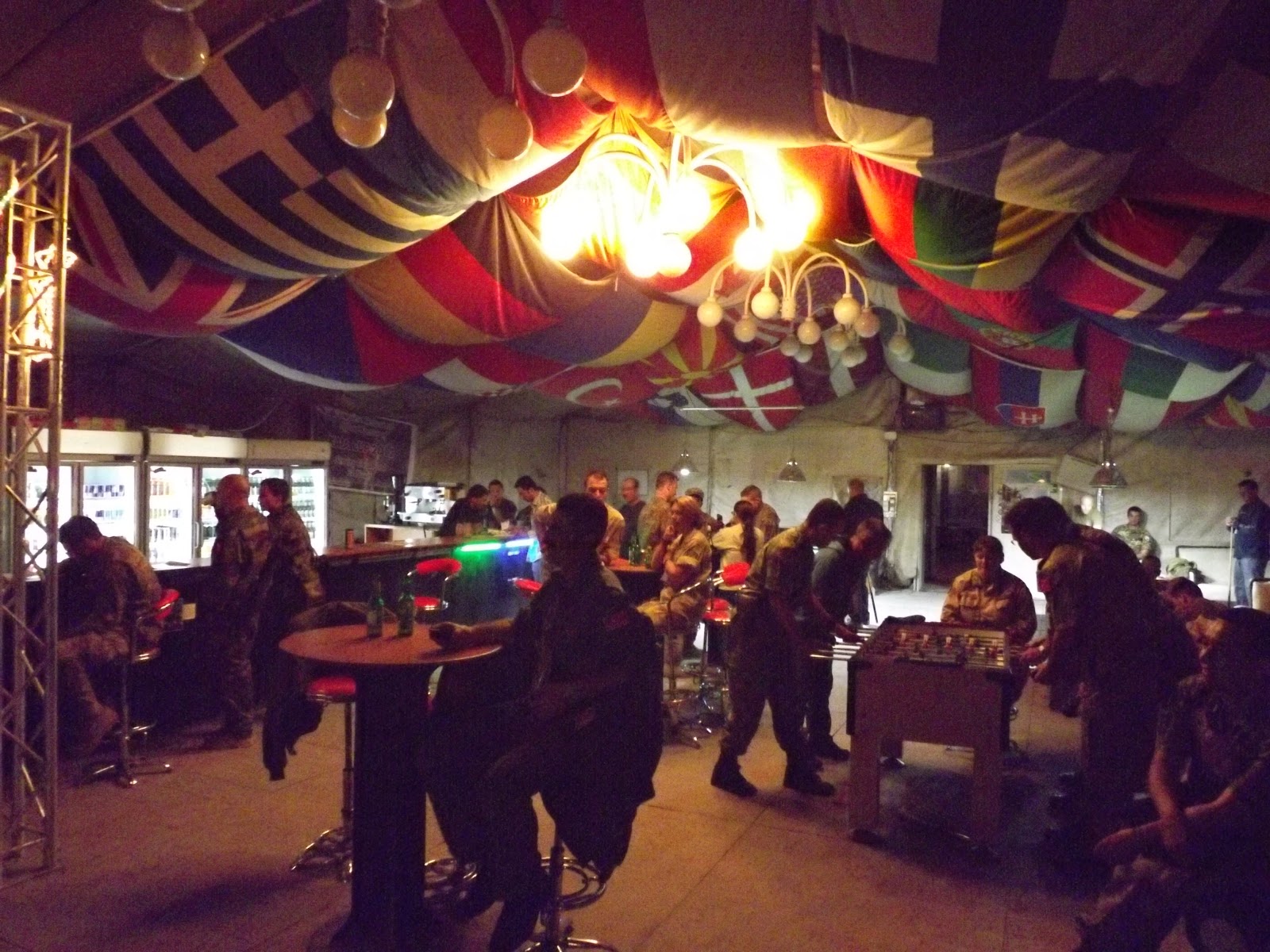
I've also stepped on to the "football pitch", or "soccer field" as it is known in America for the first time in 20 years. My predominantly international office routinely reserves the base field for soccer once a week. It is a great team-building event and helps bring together a lot of people from various countries who might typically keep their relationships work-related. Playing sports creates bonds of friendship and camaraderie. Needless to say, however, I was not very good. I was counselled quite often by some of my European teammates. But I wasn't that bad when put in goal. My Italian collegue complimented my play and one of my Slovak co-workers actually invited me out to the next week's contest. At this rate, in a year, I might be below average on the European scale. That's my goal.

Three months here also now makes Afghanistan my second longest military-based trip, surpassing my jaunt to Qatar a few years back and behind only my excursion to Bosnia back in 1998-99. So much is different between this adventure and the Bosnia mission. For one, communication. When I was in Bosnia, the internet was in its infancy and email was something I did maybe once a week. Today, as evident in this post, I am able to communicate with almost the same ease I would in the states. I can blog, tweet, post on Facebook, and most importantly, Skype. Back in 1999, video teleconferencing was barely an option, and was primarily for the married troops, and for only five minutes at a time.

Another interesting aspect of this trip compared to others has been my observation and understanding of the human side of people, both the Afghans and the other people who are here for whatever reason. Back in my military days and even probably a little beyond that, I don't think I cared as much and regarded the people around me as just playing accompanying roles in my journey. Now I ask them how they are doing and try to learn at least a little about them: where they come from, their family back home, where they want to go from here, etc. Whether I know them for a month, a week, or the whole year, it's best to make the best connections possible as we are all in this together and I might never know when I'll need their support or they might need mine. This might be based a bit on the fact that unlike my other trips, I came here by myself and will leave by myself. In this sort of environment, the people around me will come and go, again some for longer time than others.

Sorta like life.

In lighter news, I've been studying comedy a lot in my spare time, finally reading a book on the art I bought while taking a stand-up course a year and half ago. I've also been watching early episodes of Saturday Night Live almost every night and taking notes on what makes them funny. I am almost through Season 1 and have  Seasons 2-4 in my footlocker ready to be opened. This increased exposure to comedy has also led to me writing comedy bits about the base and working in Afghanistan. I hope to find my way on the base club's stage soon. It's going to be interesting performing in front of an international audience, but I'm going to give it a shot.

Finally, one last Bosnia-Afghanistan comparison: my trip to Bosnia was where I created the nom de guerre "Jordi Scrubbings". Here I am 13 years later writing on JordiScrubbings.com, still using the moniker. I guess the more things change ...

Tuesday, June 5, 2012

Afghanistan and the American Right Wing View on Media


Living and working in Afghanistan provides for some interesting experiences. None perhaps are more interesting than the conversations you can have with people from all over the world. And among those, some of the more interesting are with some of my fellow Americans.

As could be expected, most of the people working with the military in Afghanistan lean to the conservative side politically. They talk about things like “the left-wing media” and say things like “if you are under 30 and conservative, you have no heart. If you are over 50 and liberal, you have no brain.”

These statements are others of their ilk are not only ignorant, they are completely hypocritical considering the current problems of Afghanistan. These people need to poke their heads out of their myopic little holes, see the greater world around them, and stop making mountains out of what they believe are American problems.

For whatever reason, conservatives believe the “media” is an anti-military, anti-American, Communist machine. Besides the painfully ignorant fact that they only define “media” as cable television, they fail to appreciate the ability of people in America to write, say, or broadcast what they want. Americans are not jailed, beaten, or killed for blogs, videos, or tweets as they are under oppressive regimes. Many conservatives are too busy complaining and bitching about the problems they believe are with a small segment of the America media to acknowledge that American problems are not truly problems.

In Afghanistan, there is no freedom of press. If the Taliban doesn’t like what you write, they kill you. There are few Afghan media voices here documenting corruption, writing about the atrocities of the Taliban, or even telling the stories of everyday Afghans. Most of the press here is international. Few Afghans have running water, no less the ability to go online and blog, tweet, or create a youtube video. There is little press, no less conservative or liberal leaning.

There is an index called the Press Freedom Index put out annually by Reporters Without Borders. In its latest release, America was ranked 47th. Meanwhile, Afghanistan is currently ranked 150th. Syria is ranked 176th, China is ranked 174th, and Saudi Arabia is ranked 141st. What does that tell you about the Afghan freedom of press?

So before American conservatives can talk about what cable station is liberal and why it is un-American for its Globalist outlook, they should talk about the freedom of Afghans to say or broadcast what they want. They should help build successful media networks here instead of complaining about what they think is a problem back home.

Americans should be all about freedom, right?

Thursday, May 31, 2012

For Grandma


There are some things that by their very nature are incredibly difficult to write. While most writing derives from the brain, sometimes a writer must write from the heart, a practice that requires laying bare emotion and making words not only convey meaning, but also feeling. There are times when a writer must write for affect, not effect.

Although I’ve never considered writing for affect one of my strong points, this is one of those times.

Even before I was born, my grandmother had a profound impact on my life. According to my mother, my grandmother wanted her first grandson to bear the name “Michael”, and hence when I was born, I was given the name. Although being the first of nine grandsons has always meant a lot to me, it has meant as much if not more knowing that because of my place in that order, my name is directly because of my grandmother.

I never did thank her for that.

I grew up only about 15 minutes from my grandparents. I have many great memories of going to their house to eat. And eat. And eat. And eat. Being tall and skinny, my grandmother used to always tell me I had a “hollow leg” as the food surely wasn’t going to my stomach. What can I say? I was a growing boy.

While dinner during these visits was being prepared, I would often watch TV. My favorite thing to watch was Grandma’s recorded-from-HBO VHS version of Star Wars. Once my parents, grandparents, or anyone else old enough to work the VCR put in the tape and pushed the play button, I was transfixed. To this day, I firmly believe that one of the reasons I can recite all the lines to the movie is because I watched it every time we visited my grandparents’.

My grandparents moved to Florida in the mid-80s and my family followed a few years later. I didn’t know much about Florida, but I knew their house was in Inverness and Inverness had turtles. One of which my grandfather marked with a can of spray paint. Then there was the time I flipped over the front end of a bicycle and had both a concussion and a seizure. I don’t remember much of that for obvious reasons.

When my brother Eric needed to undergo cancer treatment at Shands Hospital in Gainesville, Florida, he and my mother would be gone for days if not weeks at a time. While my Dad still had to work and my brother Bryan and I still had to go to school, both of my grandmothers stayed at our house at different times to fill the role of “mom”. As my father’s mother lived in NY, she didn’t know the normal rhythm of the house. During her visits I did what I could to avoid my household chores. But when my mother’s mother was there, these antics failed miserably, as I was forced to comb my hair, wear a jacket to school, take out the trash, do the dishes, and all my other normal duties. And when I tried the “mom doesn’t make me do that” line, my grandmother knew I was lying. She knew the standard my mother kept and there was no fooling her.

A few years later, I joined the Army and left home for the first time. After a few months of training, I was stationed in the middle of Texas, at Fort Hood. Although I kept in touch with family over the phone, I rarely saw anyone until I came back to Florida on my annual Christmas leave.

Except for my grandparents.

Every year, along their trek to Las Vegas, they would make a detour to Fort Hood to see me. Sometimes we went out for lunch or dinner, and other times we would see the sights of Fort Hood. I remember the first year they visited.  One of my commanding officers was kind enough to drive me to a landmark to meet them. Along the way, he asked if they were going to Vegas to get hitched. I laughed and told him how long they had been married (just short of 50 years at that point). He was quite impressed with both their longevity and their sense of adventure.

After my stint in the military, I came back to Florida for college. Although being back in the state meant family was only a drive away, Florida State University was a long five hours from my parents’ house. But it was only two and half hours from my grandparents’, whose house was conveniently located along the way of my drive.

Almost every time I went to my parents’ house, be it for a holiday or just a long weekend, I also visited my grandparents. Sometimes it was for a quick hello, and other times it extended into an overnight stay. More often than not, however, it was for dinner. And despite Grandpa’s insistence that the kitchen would be closed when I got there, or that there would only be bread and water available, my grandmother always had something cooked up for me to eat.

And my grandmother waited up no matter how late I was. With my habit for never being punctual, it got to the point where if I said I would be there for dinner, I think my grandmother would say they were eating an hour earlier than they actually were. This way when I walked in an hour late, I arrived right as dinner was being served.

I remember one time my friend Jamal and I didn’t get to my grandparents’ house for dinner until nearly 10pm as we – wait, no, just I – decided to take the slower backroads down the west coast of Florida instead of taking the much quicker interstate. While Grandpa was retired to his room for the night, it was my grandmother who stayed up, re-heated our dinner, and sat at the table talking with us while we ate.

Jamal wasn’t the only friend my grandmother made feel at home. She also provided beds for my college roommate and me so we had a place to sleep after seeing a rock concert that played an hour away from Inverness. Because she let us stay there, we only had to drive an hour to get some rest after a night of rock’n’roll festivities instead of driving nearly four hours back to Tallahassee in the dark wee hours of night.

Seeing my grandparents as often as I could has always been important to me. While they were always both very interested in my education and then my pursuit of a career, my grandmother would also ask me questions about my investments and whether or not I was saving my money. I would not be as smart with my money as I am now if not for my grandmother.

When I moved to Tampa in 2006, visits to my grandparents decreased in frequency but increased in time. They were no longer along the route to my parents’ house, but they were only an hour and a half away. That meant I could talk and hang out with them for as long as they would have me, or as long as Grandpa kept the kitchen open.

In 1991, my father was in Saudi Arabia working with the US government doing a job similar to what I am doing now in Afghanistan. A short time after he left, my brother Eric succumbed to his long battle with cancer. I’ve thought about my Dad’s situation a lot since hearing the news of my grandmother. I can’t imagine how tough it was for my Dad to lose a son while thousands of miles from home. For me, losing a grandmother is difficult enough.

Rest in Peace, Marilyn Walicki. I’ll miss you, Grandma.

Thursday, May 10, 2012

The Sick Little Afghan Boy


A few weeks ago, I had a wicked chest cold. Unfortunately, chest colds are not uncommon here in this part of Afghanistan as the weather is a bit cool, it rains often, the air is thin, and there is a severely unhealthy amount of pollution in the air. Almost everyone gets sick at some point during the beginning of their deployment here. It is almost a right of passage. In my case, however, the environment plus the dungeonesque open bay living area I was temporarily housed in made my first weeks a tough burden on my respiratory system.

Thanks to the chest cold and my near constant coughing, sleep became difficult for a few nights. I knew I was waking not only my roommates but the entire barracks with my coughing fits. So one night, at the height of my bronchial blight, I decided to do something about it. When a fit of coughing woke me at 4am, I rolled out of bed, put on a jacket, and walked to our base clinic. As it was four in the morning, the only section of the medical facility open was the emergency room. And of course, going to the emergency room meant the doctors were going to check for everything, even if that meant giving me chest x-rays and hooking me up to an EKG.

By the time I was completely scanned, screened, poked, and prodded, it was close to 8am. With my results in hand, the Czech doctor prescribed me some antibiotics and sent me on my way. Before I could check out however, I had to walk from the emergency wing to the routine admission wing to pay for my visit.

(As a contractor, I have  to pay. Military folks get free health care. They also get paid a lot less than I do. Fair is fair.)

As I sat awaiting to pay for my medicine, I saw several local Afghans sitting on nearby benches. I heard the hospital tended to locals, but as my workplace is on the other side of the base, I never saw the medical staff in action nor anyone from the community arrive.

Although we all had a definite language barrier - my English, their Dari, and the medical staff's French - we all seemed to understand the basic process of what was going on in the waiting area. All except an elderly Afghan man with a wicked cough who wandered past the staff desk and started walking down the hall towards the patient rooms. He was quickly caught, herded back to the waiting area, and a bi-lingual staff member instructed him on the proper protocol.

While the elderly man sat to my immediate right, to my immediate left sat a young father and his three children. The father appeared to be in his late 20s, and his children looked to be somewhere around the ages of ten, seven, and maybe three. They were dressed in typical Afghan garb, with flowing robe-like outfits, sandals, and scarves wrapped around their necks. The girl of course had her scarf up on her head to cover her hair as is the custom.

It didn't take long for me to realize why the young family was in the hospital that day. They were there because of the youngest boy. Not only did he look fatigued, and his cheeks were a rosy red, but like me he also had a wicked cough, although his sounded much more meager than mine. No doubt he was hurting.

As the other two children bantered, the young boy sat quietly besides his father. The man wrapped his arm around the boy's shoulders and held him close. I could see the young father was concerned and I felt for him. While I watched the boy the father's eyes moved from his sick son to me, I wanted to tell him that his son was about the same age as my nephew; perhaps we could have built a bond. But I could tell his English was limited, and of course my Dari is non-existent.  So I just smiled and he smiled back.

After about 10 minutes of all of us waiting, the young father's healthy children started to get impatient. Seeing they needed something to occupy their interest and something that might cheer up the young boy until he could finally be seen, a French nurse brought the children a handful of beanie babies. The eyes of the sick young boy lit up with presented with the gift. I saw him smile for the first time, temporarily forgetting his illness. His brother and sister, seeing his happiness, started to engage him with their beanie babies and the young boy started laughing, before another cough stifled his fun and reminded us all why he was there.

Eventually, after only 35 minutes of sitting in the waiting area, I was finally able to pay my bill and leave. A few moments before I walked out, however, it was the little boy's turn to be seen. As his siblings remained in the waiting room, the sick little Afghan boy took his father's hand with one hand and clung tightly to his new beanie baby with the other. The pair followed another French nurse down the hall and into one of the patient rooms.

I walked out of the clinic wondering about the sick little Afghan boy. Were they able to give him something to cure him? Did he only have a common cold or the flu or was it something much worse? Did he have a capable home life where he could take his medicine, get plenty of rest, and eat and drink what he needed to stay healthy? What if international military forces weren't in Afghanistan? Where would his father have taken him?

There is a lot of talk about why the international community needs to leave Afghanistan. They say support for international presence in Afghanistan is at an all-time low. But I am positive on that day a few weeks ago, the young father of the sick little Afghan boy was among one of our greatest supporters.